
Understanding GDPR: A New Era for Data Privacy and Its Global Impact
The General Data Protection Regulation (GDPR) has undoubtedly been one of the most significant topics of global conversation in recent years, particularly in the lead-up to its enforcement. As the deadline loomed, a palpable sense of uncertainty gripped industries worldwide, each grappling with the nuances of this groundbreaking legislation. At its core, the GDPR, enacted by the European Union (EU), is a comprehensive data privacy law designed to empower individuals with greater control over their personal data. It meticulously regulates the collection, storage, processing, publishing, retention, and deletion of personal data online.
GDPR compliance mandates that any organization, irrespective of its physical location, that processes the personal data of individuals residing in the EU must adhere to strict requirements. This includes obtaining explicit consent from customers to use their data, offering unparalleled transparency regarding data practices, and fulfilling several other criteria concerning personally identifiable information (PII). What makes GDPR particularly complex and intriguing is how its principles ripple through diverse sectors, presenting each industry with its own unique set of challenges and compliance hurdles.
The Domain Industry’s Unique Battle: GDPR vs. WHOIS
Perhaps no industry has faced a more direct conflict with GDPR principles than the domain industry. When an individual registers a domain name, a public record, known as a WHOIS record, is automatically created. This record traditionally includes a wealth of personal information: the registrant’s name, contact address, phone number, and email. This practice stands in direct opposition to the core tenets of GDPR, which prioritize the protection of PII and require consent for its publication.
The public nature of WHOIS records has long been a point of contention for domain registrants. Many are unaware that their personal details are readily available in a public database until they begin receiving unsolicited phone calls and emails, often from spammers, marketers, or even malicious actors. The traditional workaround for this privacy concern has been WHOIS Private Registration. This service acts as an alias, shielding personal information by substituting it with the details of the domain registrar or a third-party privacy service. With private registration, attempts to contact the domain administrator are first filtered for spam, ensuring that only legitimate and important requests reach the registrant.
The “Simple” Solution That Isn’t So Simple: Private Registration and Opt-In Dilemmas
On the surface, continuing to widely utilize Private Registration appears to be a straightforward solution for GDPR compliance within the domain registration process. It’s a well-established service, allowing individuals who prefer not to have their information publicly displayed to mask it, much as they could before GDPR. If a registrant opts out of Private Registration, they would then provide explicit consent for their personal information to be published on the public WHOIS database. However, this seemingly simple approach quickly becomes complicated under GDPR’s stringent requirements.
The fundamental challenge lies in the GDPR’s emphasis on an “opt-in” process for consent. GDPR frames privacy as an inherent right for individuals, not merely a service they can choose if they feel inclined. This means that private registration cannot be simply an add-on service; rather, the default should be privacy, with public disclosure requiring explicit, informed, and unambiguous consent. Furthermore, not all domain extensions (Top-Level Domains or TLDs) offer Private Registration, creating inconsistencies across the global domain landscape. This patchwork of options makes a universal, compliant solution difficult to implement and manage, pushing the domain industry into a gray area of interpretation and compliance.
ICANN’s Struggle: The Gated WHOIS Proposal and Its Rejection
The Internet Corporation for Assigned Names and Numbers (ICANN), the global governing body for domain names, found itself at the forefront of this compliance dilemma. Recognizing the critical role WHOIS plays for various stakeholders beyond just domain registrants, ICANN embarked on developing a GDPR-compliant solution. Law enforcement agencies, for instance, are adamant about the importance of WHOIS lookups in their efforts to locate criminals, combat cybercrime, and ensure online accountability. Without access to registrant data, their ability to investigate and prosecute online offenses would be severely hampered.
In response to the GDPR’s impending enforcement, ICANN drafted and submitted a proposed interim model to the Article 29 Working Party (now the European Data Protection Board). This body represents the data protection authorities of all 28-member states of the European Union, making it the ultimate authority on GDPR interpretation and enforcement. ICANN’s model aimed to satisfy GDPR requirements while preserving the essential elements of the existing WHOIS structure. The core idea revolved around a “gated WHOIS” system, where certain parties would have regulated access to otherwise hidden PII.
However, this proposed model was met with rejection, as articulated in a letter from the Article 29 Working Party. Roberto Viola, the European Commission’s Director-General of Technology and Communications, stated:
“Given the level of abstraction of the models, it is difficult to assess the scope and impacts of the proposed approaches. The Commission, therefore, encourages ICANN to further develop possible options in cooperation with the community in order to balance the various legal requirements, needs, and interests.”
In essence, the response politely but firmly conveyed, “No, try again.”
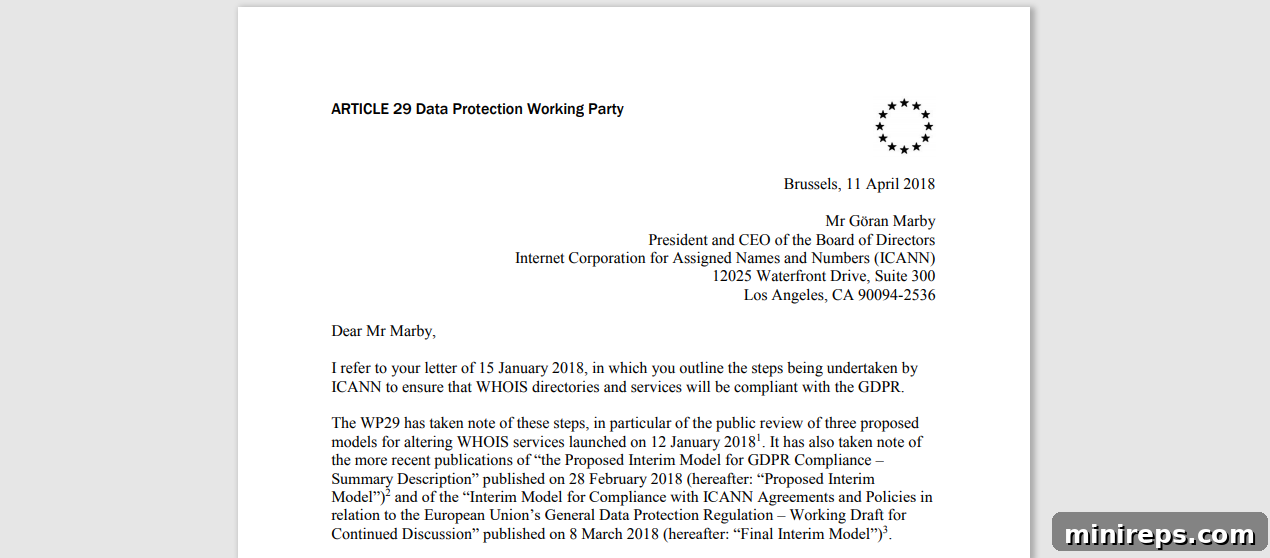
The “abstraction of the models” critique primarily referred to the lack of clarity regarding precisely who would have access to the gated data and under what specific conditions. This ambiguity raised significant concerns for data protection authorities, who prioritized the principle of data minimization and strict access controls. The rejection highlighted the fundamental challenge of balancing competing interests: the individual’s right to privacy versus the legitimate needs of various stakeholders.
Balancing Act: Stakeholder Agendas and the Need for Uniformity
The debate surrounding WHOIS and GDPR compliance underscores a complex interplay of agendas among diverse stakeholders. Each group has legitimate concerns that must be addressed in any comprehensive solution:
- Law Enforcement Agencies: They worry that a world without an accessible WHOIS mechanism could create a haven for criminals to operate online anonymously, severely impeding cybercrime investigations and national security efforts. The ability to quickly identify and contact domain registrants is often crucial in tracking down malicious actors.
- Intellectual Property (IP) and Trademark Professionals: These experts rely on WHOIS data to identify domain owners in cases of trademark infringement, domain squatting, and counterfeiting. Without access to registrant information, serving takedown notices or pursuing legal action against infringers would become nearly impossible, jeopardizing brand protection efforts.
- The Domain Industry (Registries, Registrars, Resellers): The entire ecosystem, comprising Registries (who operate TLDs), Registrars (who sell domain names), and their customers, is looking to ICANN for a uniform, globally accepted solution. The current lack of a unified approach has led to a proliferation of ad-hoc privacy policies introduced by individual Registries and Registrars. This fragmentation forces Registrars to adapt and adhere to myriad different data handling methods, creating operational complexities, potential compliance gaps, and delays in domain registration and customer support. The administrative burden and risk of non-compliance for these entities are substantial.
Ultimately, while every organization genuinely aims to comply with GDPR and “get their ducks in order,” the domain industry desperately needs uniformity. A fragmented approach not only complicates operations but also introduces inconsistencies in data protection across different domain names and regions, potentially undermining the very privacy goals GDPR seeks to achieve.
Beyond Domains: GDPR’s Broad Reach and Future Implications
The implications of GDPR extend far beyond the specific challenges faced by the domain industry. It fundamentally reshapes how every company that interacts with EU residents’ data conducts business, regardless of where that company is based. This includes not only foreign entities seeking to engage with persons in the EU but also every company physically located within the EU. Every facet of a European Union company’s business model must comply, from their marketing strategies and customer service interactions to something as seemingly simple as how they manage their own employees’ private data, including HR records and payroll information.
The complexity is further amplified when one considers other industries that heavily rely on records containing personally identifiable information. The medical industry, for example, handles sensitive health records; the financial industry manages personal financial data; and insurance companies process a vast array of personal details. These sectors face similar, if not more intricate, challenges in balancing data utility with the stringent privacy requirements of GDPR. They must implement robust data protection measures, ensure consent management, facilitate data portability, and establish clear processes for data access and erasure—all core rights granted to individuals under GDPR.
As the EU commenced active enforcement of GDPR on May 25th, it signaled a clear intent to uphold these new standards. The regulation carries significant penalties for non-compliance, including fines of up to €20 million or 4% of a company’s annual global turnover, whichever is greater. This underscores the seriousness with which the EU approaches data privacy and compels organizations worldwide to take their obligations seriously.
For the domain industry, in particular, numerous critical decisions still need to be made. All involved parties—ICANN, Registries, Registrars, data protection authorities, law enforcement, and intellectual property organizations—are actively working to find and implement solutions that strike a delicate balance between the interests of all stakeholders, ensuring both privacy and the functional integrity of the internet. The journey towards comprehensive GDPR compliance is ongoing, demanding continuous collaboration and innovation to navigate this new era of data protection.