

Demystifying the Domain Industry: Your Essential Guide to Jargon and Key Concepts
Navigating the vast and dynamic world of domain names can often feel like learning a new language. The industry is rife with specialized terms and acronyms that can be confusing for newcomers and seasoned professionals alike. Whether you’re a burgeoning entrepreneur, a digital marketer, or simply curious about how the internet’s addressing system works, understanding these fundamental concepts is crucial for building a strong online presence and making informed decisions.
This comprehensive guide aims to strip away the complexity, clarify the most common industry jargon, and equip you with the knowledge to speak confidently about domain names. We’ll break down each term, explain its significance, and help you understand the intricate ecosystem that powers every website address on the internet. Get ready to master the lingo and elevate your understanding of the digital landscape!
Registry: The Custodian of Domain Name Extensions
At the highest level of the domain name system stands the Registry. These are the authoritative organizations responsible for owning, operating, and managing specific domain name extensions, also known as Top-Level Domains (TLDs). Think of a Registry as the brand owner and primary administrator for a specific TLD like .COM, .ORG, or newer extensions such as .ART or .VEGAS. Each domain name ending is a distinct product and brand under the Registry’s stewardship.
Registries perform several critical functions. They set the rules and policies for their respective TLDs, maintain the central database of all registered domain names under that TLD, and define the pricing structure that registrars must follow. Some Registries specialize in just one prominent TLD, while others, like Afilias (now part of Identity Digital), manage a diverse portfolio, including .INFO, .PRO, .ORGANIC, .LGBT, .VOTE, .POKER, .ASIA, .AERO, .VEGAS, and .XXX. Their role is foundational to the stability and organization of the internet, ensuring that each domain name is unique and properly accounted for within its designated extension.
Registrar: Your Gateway to Domain Ownership
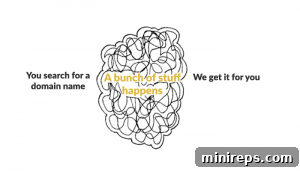
If the Registry is the manufacturer, then the Registrar is the authorized retailer. We, as registrars, act as the crucial intermediary between you, the end-user (registrant), and the domain Registry. Our primary function is to facilitate the registration, renewal, and management of domain names on behalf of our customers. When you decide to acquire a domain name, you interact directly with a registrar.
Registrars are accredited by ICANN (Internet Corporation for Assigned Names and Numbers), the global body that coordinates the internet’s unique identifiers. This accreditation ensures that registrars adhere to strict operational and ethical standards. Our work involves much more than simply processing a payment; we handle all the behind-the-scenes processes, from submitting your desired domain name to the appropriate Registry for processing and activation to managing DNS settings and providing customer support. While some domain registrations can be automated, many require manual review and approval by our staff and the Registry, especially for specialized or restricted TLDs. Essentially, we make the complex process of securing your digital identity seamless and accessible.
Registrant: The Proud Owner of a Domain Name
Simply put, the Registrant is you! Or your business, your client, a domain investor (domainer), or any individual or entity that successfully registers and holds the rights to a specific domain name. The registrant is the legal owner of the domain name for the duration of its registration period.
As a registrant, you have specific rights and responsibilities. Your rights typically include the exclusive use of the domain name (as long as it’s active and renewed), the ability to transfer it to another registrar or sell it, and the control over its DNS settings. Your responsibilities include providing accurate contact information, keeping that information up-to-date (as mandated by ICANN), and ensuring timely renewals to prevent your domain from expiring and becoming available to others. Accurate registrant information is vital for maintaining the integrity of the domain name system and for resolving any disputes that may arise concerning ownership or usage. Owning a domain name signifies a foundational step in establishing your online identity or brand.
Domainer: The Art and Science of Domain Investing
A Domainer, also known as a domain investor, is an individual or company that strategically acquires domain names with the intent of selling them later for profit. These aren’t simply random purchases; domainers often possess a deep understanding of market trends, branding, keyword relevance, and the intrinsic value of short, memorable, or industry-specific domain names.
Domainers operate in what’s called the “domain aftermarket,” where previously registered domains are bought and sold. Their investments are made from experience and a keen insight into what makes a domain name valuable. This can include factors like strong keywords, brandability, potential for high organic traffic, or suitability for emerging industries. Domain investing can range from acquiring premium domains that command high prices to building a portfolio of niche domains. Successful domainers are adept at identifying undervalued assets, understanding future market needs, and navigating the complexities of domain appraisal and sales, distinguishing legitimate opportunities from speculative ventures.
New gTLD: Expanding the Digital Frontier
For decades, the internet was largely defined by a handful of “generic” Top-Level Domains (gTLDs) like .COM, .ORG, and .NET. However, the introduction of New gTLDs marked a revolutionary expansion of the domain name space. These are modern, purpose-driven domain extensions launched since 2012, designed to provide more specific and descriptive options beyond the traditional choices.
New gTLDs like .ART, .VIP, .SHOP, .TECH, or even .NYC offer businesses and individuals the opportunity to create more relevant, memorable, and branded online identities. They help to purposefully categorize content on the internet, allowing users to get a clear sense of your brand, products, services, or mission before they even visit your website. For example, a photography studio might opt for a .PHOTO domain, while a technology startup might choose .TECH. This strategic choice not only enhances brand recognition but can also improve user experience and potentially aid in search engine optimization by providing clearer context. The proliferation of new gTLDs has opened up a world of creative possibilities for digital branding and online presence.
ccTLD: Global Reach with Local Identity
Every nation and territory in the world is assigned a unique two-letter country code Top-Level Domain (ccTLD), representing its presence on the internet. Examples include .UK for the United Kingdom, .DE for Germany, .JP for Japan, and .TR for Turkey. These domains are crucial for establishing a local online presence and targeting specific geographic markets.
The rules for registering ccTLDs vary significantly. Some country code domains are “restricted,” meaning they impose specific requirements on registrants, such as having a physical address, a business license, or legal presence within that country. These restrictions are often in place to ensure that the domain is genuinely tied to the nation it represents, fostering trust and authenticity. Conversely, other ccTLDs are “unrestricted,” allowing anyone from anywhere in the world to register them without local presence requirements. For restricted ccTLDs, many registrars offer exclusive Trustee Services or local presence services. This allows you to register a domain in a country even if you don’t meet the local presence criteria, by having a local entity act as a proxy or trustee on your behalf. This service is invaluable for international businesses looking to establish a strong local digital footprint and connect with regional audiences.
Domain Hack: Creative and Memorable Branding
A Domain Hack is a clever and creative use of a domain name, typically involving a ccTLD, to form a complete word, phrase, or brand name when combined with the second-level domain. The ccTLD, originally intended to denote a country, is “hacked” and adopted for its phonetic or semantic contribution to the overall name, often extending beyond its national pride purpose to target an international market with a distinctive brand message.
For example, del.icio.us (using the .US ccTLD) or goo.gl (using the .GL ccTLD for Greenland, but used by Google for URL shortening) are classic examples. These hacks are memorable, often witty, and can create a unique brand identity that stands out. They leverage the global availability of ccTLDs to construct catchy and recognizable web addresses, making a lasting impression on users. The ingenuity behind domain hacks lies in transforming a technical identifier into an integral part of a brand’s linguistic identity, demonstrating creativity in the digital naming space.
IDN: Bridging Language Barriers on the Internet
Internationalized Domain Names (IDNs) are domain names that contain characters from non-Latin alphabets or scripts, allowing users to register and use domain names in their native languages. This includes languages like Arabic, Chinese, Cyrillic (Russian, Ukrainian, Serbian), Hindi, Japanese, Korean, Tamil, Thai, and Hebrew, among many others.
The advent of IDNs represents a significant step towards a truly global and inclusive internet. By enabling domain names in local scripts, IDNs help you connect with your target audience in their preferred language, fostering a more comfortable and intuitive online experience. Users whose native language is not English can navigate your website and address emails using familiar characters, removing potential language barriers and increasing accessibility. Registering an IDN domain name demonstrates a commitment to a diverse user base and can significantly enhance your brand’s reach and relevance in non-English speaking markets. It’s about making the internet truly universal, one language at a time.
Parking: Monetizing Idle Domain Names
Domain Parking refers to the practice of registering a domain name but not actively using it to host a full-fledged website or email service. Instead, the domain simply displays a temporary placeholder page, often featuring advertisements, links, or a “for sale” message. Parked domains are not “live” in the traditional sense of a developed website but are utilized to monetize the traffic that might visit the domain, or to signal its availability for acquisition.
Domainers frequently use parking as a strategy to generate passive income from their domain portfolios. By displaying pay-per-click (PPC) ads or other offers on a parked page, they can earn revenue from visitors who type in the domain directly or arrive via search engines. Parking also serves as a clear indication that a domain is available for sale, often displaying contact information for interested buyers. While not a substitute for a robust website, domain parking is an effective method for capitalizing on the inherent value of an unused domain name, transforming potential traffic into tangible returns or facilitating future transactions.
WHOIS: The Public Directory of Domain Ownership
The WHOIS database is a publicly accessible online directory that contains essential information about every registered domain name. This information typically includes the full name, contact details (email, phone, address), and technical details (name servers, registration and expiry dates) of the domain’s registrant (owner), administrative contact, and technical contact. It serves as a vital resource for transparency and accountability within the domain name system.
Historically, WHOIS provided comprehensive public access to domain owner data. However, with the advent of stricter data privacy regulations like GDPR (General Data Protection Regulation), access to personal contact information has become more restricted, particularly for individual registrants. Many registrars now offer “WHOIS privacy protection” or “proxy services,” which allow the registrar’s generic contact information to be displayed publicly instead of the registrant’s personal details, protecting their privacy while still meeting the technical requirements of the WHOIS database. Despite these changes, WHOIS remains an indispensable tool for verifying domain ownership, troubleshooting technical issues, and ensuring the stability and security of the internet’s addressing system.
Resolve: Bringing a Domain to Life on the Internet
In the context of domain names, to Resolve means the process by which a domain name (like example.com) is translated into an IP address (like 192.0.2.1) that computers can understand. This fundamental process is handled by the Domain Name System (DNS) and is what allows your web browser to find and load a website when you type in a domain name.
When you enter a domain name into your browser, a series of queries are sent through DNS servers to find the corresponding IP address where the website’s content is hosted. Once resolved, your browser can then connect to that server and retrieve the website. This process involves “name servers” which hold the key information mapping domain names to IP addresses. Therefore, when discussing domain activation, it’s common to hear statements like, “In some instances, it may take additional time for the name servers to resolve,” indicating the propagation time required for DNS changes to update across the internet globally. A domain that resolves correctly is crucial for a website to be accessible.
Live: Your Website is Open for Business
When a website is considered Live, it means it is fully active, accessible to the public over the internet, and ready to be used by visitors. This isn’t an automatic state simply upon registering a domain name; rather, it’s the culmination of several steps.
For a domain name to go “live” with a website, it must first be registered, its DNS settings must be configured to point to a web hosting server, and the actual website content (HTML, CSS, images, etc.) must be uploaded and correctly set up on that server. Only then can users type your domain name into their browser and view your website. As such, phrases like, “However, just because you have a domain name does not mean that your website will be brought to live automatically,” emphasize that registration is just the first step in a multi-stage process to establish a fully functional online presence. A live website signifies that your digital storefront is open for business.
Responsive: Adapting to Every Screen
Responsive web design refers to a web development approach that ensures websites deliver an optimal viewing experience across a wide range of devices and screen sizes. This means that a website will automatically adjust its layout, images, and content to look good and function effectively whether a user is viewing it on a desktop computer, a tablet, or a smartphone.
The core principle behind responsive design is flexibility. Instead of creating separate websites for different devices, a single responsive website uses flexible grids, images, and CSS media queries to adapt dynamically to the user’s environment based on screen size, resolution, and orientation. In today’s mobile-first world, having a responsive website is no longer a luxury but a necessity. As the original content rightly noted, “Websites in 2017 needed to have responsive layouts and mobile-first design,” a sentiment that is even more critical today. A responsive design improves user experience, reduces bounce rates, and is a significant factor in search engine optimization, as major search engines prioritize mobile-friendly websites.
Understanding these foundational terms is your first step towards confidently navigating the digital landscape. The domain industry is constantly evolving, but these core concepts remain the pillars upon which the internet’s addressing system is built. From the Registries that govern extensions to the Registrars who make ownership possible, and the savvy Domainers who invest in digital real estate, each player contributes to a robust and dynamic ecosystem. Embracing new developments like gTLDs and IDNs, and ensuring your online presence is live and responsive, are key to success in the modern web.
Stay curious, keep learning, and don’t hesitate to engage with the domain community! Share your favorite domain industry insights or questions with us on social media.