

In today’s hyper-connected business landscape, your company’s domain name transcends being merely an online address; it is the indispensable cornerstone of your entire digital presence and operational integrity. This singular, foundational asset dictates not only where your customers locate your website but also the secure delivery of your confidential email, the authenticity of your customer communications, and the very proof of your identity across the vast expanse of the internet. Without it, your online identity collapses, impacting every facet of your digital operations.
Considering its paramount importance, how are you safeguarding this invaluable digital deed? For a significant number of businesses, the primary layers of defense involve robust passwords and two-factor authentication (2FA). While essential, this approach is akin to storing the physical deed to your most valuable real estate in a desk drawer, albeit one secured with a sturdy lock and key. It offers a sense of security, yet it remains fundamentally vulnerable. The critical question arises: what happens when a highly sophisticated cyber attacker bypasses these initial defenses, successfully executes a domain hijacking, and illicitly obtains that key?
The Escalating and Pernicious Threat of Domain Hijacking
While the implementation of strong, complex passwords and multi-factor authentication, such as two-factor authentication, represents critical baseline security measures, they are, regrettably, not infallible. Domain hijacking stands as a very real, rapidly evolving, and increasingly prevalent threat that demands urgent attention from businesses of all sizes. Attackers are constantly refining their techniques, often targeting the weakest link in any security chain: human behavior.
It takes merely a single point of failure, often originating from a seemingly innocuous human error or a cleverly executed social engineering tactic, for a determined attacker to gain unauthorized access to the “key” to your domain registrar account. Once this critical access is achieved, the repercussions extend far beyond a mere theft of your domain’s registration details; they effectively seize your entire digital estate. In an alarming instant, the perpetrators can initiate a cascade of devastating actions:
- Compromise and Alter Your Domain’s Nameservers: This is a primary objective for hijackers. By maliciously changing your domain’s nameservers, attackers can redirect all incoming web traffic from your legitimate website to a fraudulent, look-alike site. These deceptive sites are meticulously crafted to steal sensitive customer data, including login credentials and financial information, or to distribute malware to unsuspecting visitors. From an external perspective, this hostile site appears indistinguishable from your authentic business, leading to widespread customer confusion, data breaches, and severe reputational damage that can take years to rebuild.
- Intercept and Redirect Your MX Records: Manipulating your domain’s Mail Exchange (MX) records grants attackers a direct pipeline into your company’s email communications. This allows them to intercept every single email sent to or from your organization. This includes highly sensitive internal communications, critical financial reports, confidential client invoices, proprietary trade secrets, and even personal employee data. Such interception can lead to corporate espionage, devastating data leaks, and immediate financial fraud.
- Initiate Email Communications From Your Trusted Domain: With full control over your email infrastructure, attackers can leverage your domain’s credibility to launch sophisticated phishing and spear-phishing campaigns. They can send convincing “password reset” requests to your customers to hijack other accounts, issue fraudulent wiring instructions to your accounting department resulting in significant financial losses, scam your business partners, and completely erode the invaluable trust you’ve painstakingly built with your stakeholders over many years. This form of impersonation is incredibly difficult to detect for the end-user and can cause immense direct and indirect damage.
- Gain Unauthorized Access to Other Third-Party Services: Many critical third-party business services, including cloud platforms (e.g., AWS, Azure, Google Cloud), financial portals, customer relationship management (CRM) systems, and payment gateways, rely on domain email for account verification and password recovery. By controlling your domain email, attackers can exploit these verification mechanisms to reset passwords and infiltrate a wide array of your critical systems, leading to a sprawling breach that can compromise your entire technological ecosystem.
The cumulative consequences of such an attack are immense and multifaceted: ranging from catastrophic financial losses and severe legal liabilities to irreparable brand damage, loss of intellectual property, and a complete, agonizing loss of operational control. The business disruption can be severe, potentially leading to prolonged downtime and a significant struggle for recovery.
Introducing the Ultimate Defense: Registry Lock
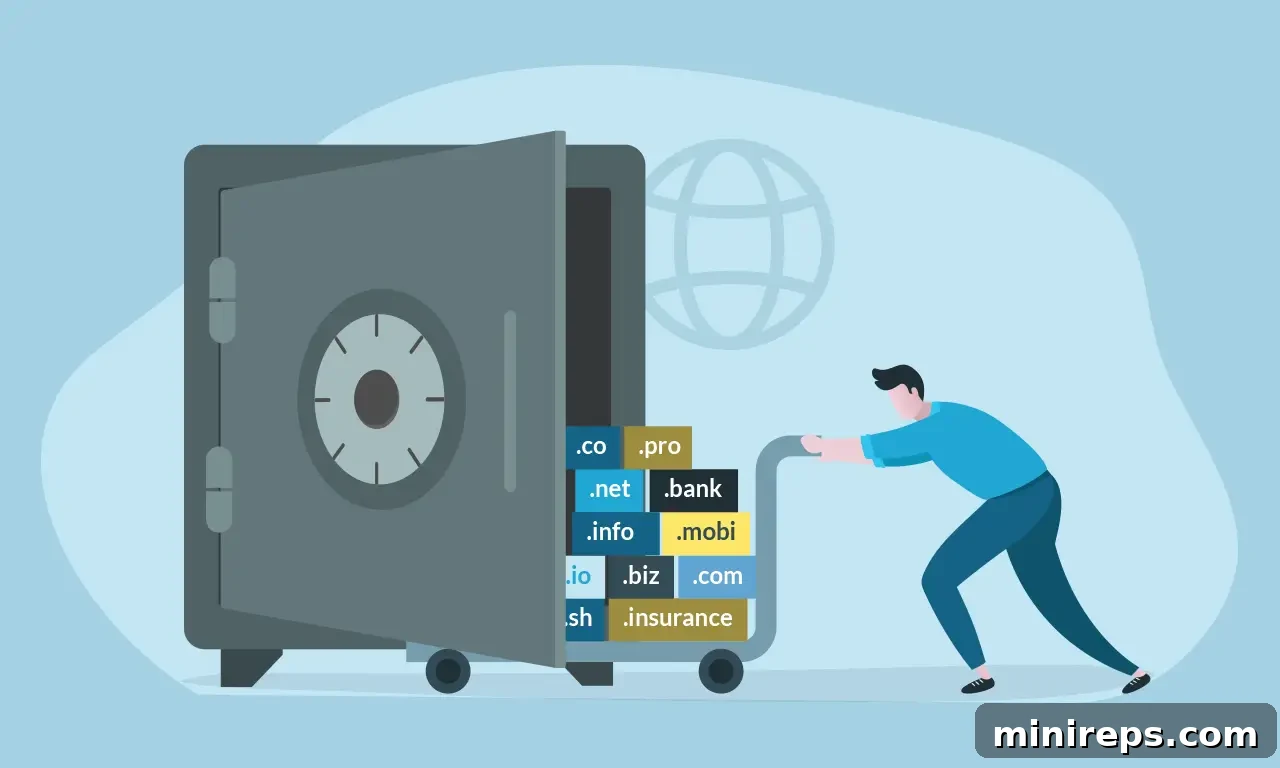
If the conventional password serves as a standard filing cabinet lock, then Registry Lock stands as an impregnable, maximum-security vault specifically designed to protect your most critical digital asset. It represents an unparalleled layer of security, fundamentally changing the risk profile of your domain.
Registry Lock offers the definitive and highest possible tier of protection against domain hijacking by securing your domain name directly at its authoritative source: the domain registry itself. This means that once a domain is fortified with Registry Lock at the top-level registry, absolutely no critical changes can be made to its registration details, nameservers, or contact information. This protective barrier holds firm, even if a sophisticated attacker were to somehow gain full administrative access to your 101domain account or any other registrar account.
Conceptually, envision Registry Lock as integrating a sophisticated, multi-party, and distinctly offline security protocol directly onto the digital deed of your most valuable online asset. Any unauthorized or even accidental attempt to modify, transfer, delete, or make other fundamental changes to your domain will be immediately and unequivocally rejected by the registry’s robust systems, long before it can even reach your registrar account. This proactive rejection capability fundamentally negates the effectiveness of stolen credentials, ensuring your digital estate remains firmly under your control.
How Does Registry Lock Function in Practice?
The process for making any change to a domain name protected by Registry Lock is purposefully designed to be an intentional, meticulously controlled, and highly multi-layered procedure. It explicitly requires direct, verifiable human interaction at every critical juncture, thereby entirely eliminating the prevalent risks associated with unauthorized access, automated attacks, or simple human error. This systematic approach ensures that only legitimate, fully authenticated requests can ever proceed.
- Formal Request Initiated by the Primary Account Holder: The entire process for unlocking or modifying a Registry Locked domain must be formally initiated by the designated primary account holder on record. To establish an additional layer of delegated authority, should other individuals need to request changes, the primary account holder is required to provide a formal letter. This letter must be presented on official company letterhead, explicitly name and authorize the specific individuals to act on behalf of the primary account holder, and bear the authentic signature of the account holder. This step ensures that requests originate from a verified and authorized source, preventing internal and external impersonation attempts.
- Rigorous Live Voice Verification: Following the formal request, a dedicated and highly trained security specialist from 101domain will directly contact the primary account holder (or their formally authorized delegate) via phone. During this crucial live call, the specialist will undertake a thorough identity verification process, confirming their identity by cross-referencing and verifying a series of pre-established security questions and confidential account details. This vital, real-time human verification step serves as an impenetrable barrier against sophisticated phishing attacks and ensures the authenticity and legitimacy of the request, making it virtually impossible for an unauthorized party to proceed.
- Direct Registry Authorization and Confidential Protocol: Only after the successful and complete verification by 101domain’s security team, an authorized senior manager at 101domain will manually submit the official unlock request directly to the authoritative domain registry. The registry, in turn, does not simply accept this request at face value. Instead, it conducts its own independent verification process, typically through a direct phone call with 101domain management, during which a confidential, pre-arranged passphrase or code is exchanged and confirmed. This final, highest-level verification between two trusted entities ensures maximum security and prevents any single point of compromise.
It is only after the successful completion of this exhaustive, multi-step, human-verified, and distinctly offline authentication process that the domain name is temporarily unlocked. Our team then proceeds to make the necessary, pre-agreed changes within a precisely specified and mutually agreed-upon timeframe. Critically, immediately upon the completion of these modifications, the domain is promptly and automatically re-locked, thereby placing your digital deed safely and securely back into its impenetrable vault.
Which Top-Level Domains (TLDs) Support Registry Lock?
Registry Lock is an increasingly vital security service and is proudly supported by the registries of many of the world’s most widely used and critical top-level domains. The availability of this enhanced security measure is continuously expanding, with more TLDs being added to the list of protected domains on a regular basis. This ensures that businesses can protect their digital assets regardless of their chosen domain extension. Here is a selection of some of the most common and essential domains for which we proudly offer Registry Lock protection:
.ac, .bank, .biz, .co, .com, .info, .insurance, .io, .mobi, .net, .pro, .sh, .us
The availability of Registry Lock for specific TLDs can sometimes vary based on registry policies and technical implementations. Therefore, if your particular domain extension is not explicitly listed above, we strongly encourage you to contact our dedicated security team. Our experts are readily available to provide comprehensive information regarding the current options and availability of Registry Lock for your specific domain, ensuring you can make informed decisions about your digital asset protection strategy.
RELATED ARTICLE: Registry Lock: How to have “the talk” with your IT team
The Deed to Your Digital Estate Demands the Security of a Vault
The landscape of cyber threats is in constant evolution, with cyberattacks growing exponentially in sophistication and cunning. Attackers meticulously employ advanced tactics such as social engineering, targeted phishing campaigns, and malware distribution to exploit even a single human error or system vulnerability, ultimately gaining unauthorized access to the keys to your crucial domain account. This illicit access can quickly escalate into a catastrophic digital disaster for any business.
With **Registry Lock**, you are empowered with the definitive solution to render those stolen keys utterly useless. It acts as an impenetrable safeguard, preventing anyone – regardless of whether they possess stolen login credentials or even full administrative access to your registrar account – from making fundamental and damaging changes to your domain name’s core registration details, nameservers, or any critical records. This proactive security measure ensures that your digital foundation remains unassailable, providing peace of mind in an increasingly turbulent digital world.
For an investment that amounts to less than $1 per day, you can secure the continuity of your business operations, guarantee the privacy and integrity of your communications, and ensure that your foundational digital assets remain unequivocally and firmly within your control. The choice, therefore, becomes remarkably clear and simple: would you prefer to leave the irreplaceable deed to your entire digital estate vulnerable in a mere desk drawer, exposed to the ever-present dangers of sophisticated cyber threats, or would you opt to secure it within the unyielding protection of a maximum-security vault?
In an era where your online presence is synonymous with your business’s existence, investing in the highest level of domain security is not merely an option; it is an absolute imperative for resilience, reputation, and robust business continuity. Protect your legacy, secure your future.
Domain Name Services
We are renowned for our global reach and capabilities, offering an extensive suite of services and expert support tailored to empower you in making informed, critical decisions. Our commitment ensures your brand’s digital presence is consistently protected and optimized for success.
Monitoring & Enforcement Services
Our advanced monitoring solutions, powered by dedicated analysts, operate around the clock to safeguard your digital assets. Should a threat be detected, we provide swift, in-house solutions to efficiently resolve issues and mitigate risks, ensuring continuous brand protection.
Our Security & Technology Partners
As a leading security-focused domain name and web technology provider, we offer a comprehensive ecosystem of complementary services and collaborate with best-in-class partners. These resources are readily available to you, ensuring robust security and cutting-edge solutions precisely when you need them.