


The digital landscape offers unprecedented opportunities for businesses to expand their reach, connect with global audiences, and drive significant online revenue. However, this same vastness also presents a fertile ground for cybercriminals and opportunistic infringers. In today’s interconnected world, safeguarding your brand against digital threats is no longer optional; it’s an absolute necessity. Unscrupulous actors can easily impersonate your business, selling counterfeit products, spoofing your emails to defraud customers, or registering domain names that intentionally mislead consumers. The sheer volume of new domain registrations daily makes it virtually impossible for businesses to manually track every potential threat to their trademark. This challenging reality is precisely why proactive domain monitoring and brand protection strategies have become indispensable tools for modern enterprises.
While comprehensive brand monitoring services offer extensive protection, they may not always align with every budget. Fortunately, there’s a powerful and cost-effective solution that provides an essential layer of defense: registering your trademark with the Trademark Clearinghouse (TMCH). Think of the TMCH as a foundational domain monitoring service, acting as your early warning system. It proactively notifies you if any entity attempts to register a domain name incorporating your registered trademark within any of the new generic Top-Level Domains (new gTLDs), regardless of which domain registrar they use. This immediate alert system empowers you to take swift action, preventing potential harm to your brand before it escalates.
Understanding the Trademark Clearinghouse: Your First Line of Defense
The Trademark Clearinghouse (TMCH) was established in direct response to the monumental expansion of the internet’s domain name system. This expansion began with the new generic Top-Level Domain (gTLD) program launched by ICANN (Internet Corporation for Assigned Names and Numbers) in 2012. This program dramatically diversified the domain name space, moving beyond traditional extensions like .com, .org, and .net, by introducing hundreds of new, descriptive, and often industry-specific domains. Since its inception, dozens of new gTLDs have been introduced every year, constantly reshaping the digital landscape.
For instance, in recent years, we’ve seen the launch of innovative extensions such as .channel, .giving, .rsvp, .boo, and .kids. The pace of these launches shows no signs of slowing, with numerous new domains already scheduled to debut in the coming years. While many of these new domains can be incredibly .fun and open up exciting possibilities for businesses and individuals, they also introduce significant challenges for brand protection. With an ever-growing number of domain extensions, the potential for trademark infringement, cybersquatting, and brand abuse multiplies exponentially.
The Trademark Clearinghouse was specifically designed to address these concerns by considering the rights of trademark holders throughout the new domain registration process. New domains are typically launched in carefully structured phases, and critically, every new gTLD launch is mandated to include a “Sunrise phase.” This exclusive Sunrise phase provides trademark holders who have registered their marks with the TMCH an invaluable opportunity. During this period, only verified trademark owners can secure domain names corresponding to their registered marks before these domains become available to the general public in later registration phases. This pre-emptive registration capability is a cornerstone of proactive brand defense, allowing businesses to claim vital digital real estate and prevent others from squatting on their brand names.
RELATED ARTICLE: What goes into a Domain Launch you ask? Discover the intricacies behind new domain releases.
Unlocking Proactive Brand Protection with TMCH Domain Registration Alerts
Beyond the benefit of participating in Sunrise phases, a major and perhaps even more critical advantage of registering your mark with the Trademark Clearinghouse is its integrated domain monitoring and “Claims Service.” This service functions as an automated vigilance system, providing an invaluable layer of security for your intellectual property.
Here’s how it works: Once your trademark is validated and recorded within the TMCH database, you will automatically receive a notification via email whenever a third party attempts to register a domain name that matches or is confusingly similar to your trademark within any new gTLD. This alert is triggered regardless of which domain registrar the registrant uses. The email typically provides crucial details, including the domain name being registered, the specific new gTLD, and the date of registration. Importantly, the registrant attempting to register the domain name also receives a notification, informing them that their chosen domain name matches a registered trademark and warning them of potential infringement issues.
This early warning system is an immensely powerful tool. It provides trademark holders with critical information in real-time, allowing them to get ahead of potential brand abuse. Knowing immediately when an infringing domain is registered empowers you to assess the threat and take strategic action quickly. Without such a system, discovering an infringing domain might only happen after significant damage has already been done—whether through customer confusion, reputational harm, or financial losses due to phishing or counterfeiting operations. The TMCH Claims Service transforms brand protection from a reactive clean-up operation into a proactive defense strategy, minimizing risks and safeguarding your brand’s integrity across the ever-expanding internet.
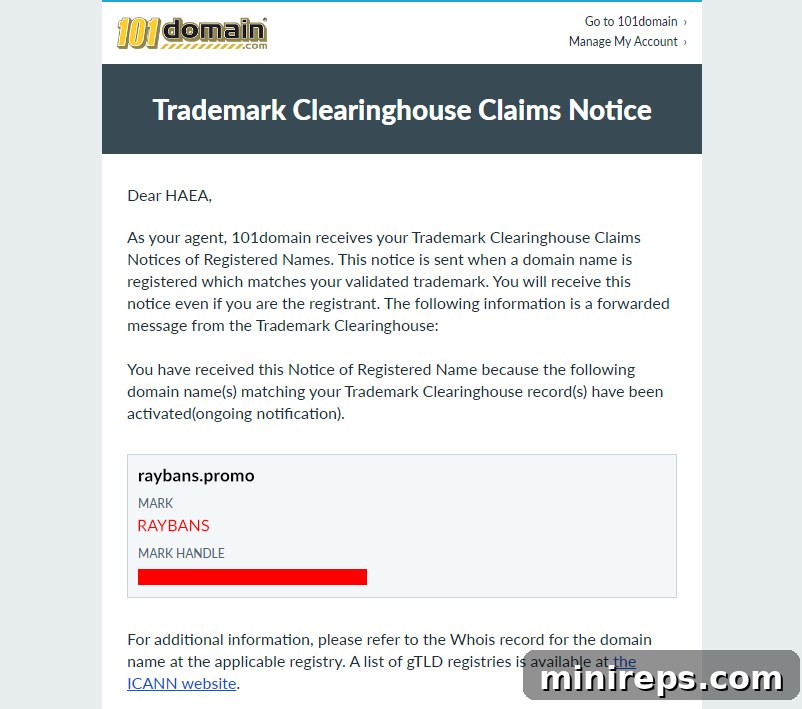
Navigating Domain Disputes: What to Do if Your Trademark is Registered
Receiving an alert from the Trademark Clearinghouse that someone has registered a domain name infringing on your trademark is the first step in reclaiming your digital rights. While concerning, this notification provides you with the opportunity to act. There are several strategic paths you can take to recover domain names infringing on your trademark, each with its own advantages and considerations. The most suitable path will largely depend on the specific circumstances of the infringement, including how the domain name is being used (or not used), the intent of the registrant, and your desired outcome.
Acquire the Domain Name Directly
In certain scenarios, the most straightforward and often quickest path to resolution is to acquire the infringing domain name directly. This option is particularly viable if the domain name is either not actively being used or is explicitly listed for sale at a reasonable price by a domain investor or even a cybersquatter. Engaging a professional service, such as 101domain’s domain concierge service, can be highly beneficial here. Our service allows you to pursue the acquisition anonymously, which can prevent the seller from inflating the price upon realizing a major brand is interested. While paying a domain investor or cybersquatter might feel like conceding, it can sometimes be the path of least resistance, saving you significant time, legal fees, and administrative burdens associated with more contentious dispute resolution processes. It’s a pragmatic solution when speed and minimal friction are priorities.
Send a Cease & Desist Letter
For many instances of potential trademark infringement, a formal cease & desist letter is an effective initial step. This legal document formally notifies the domain registrant of your trademark rights and demands that they cease their infringing activities, which typically includes relinquishing the domain name. Our experienced team at 101domain can help you determine the best approach and draft a compelling letter tailored to your specific situation, outlining the legal ramifications if the infringement continues. A well-crafted cease & desist letter is often enough to persuade an opportunistic domain owner to remove or transfer control of the offending domain. This option is frequently a good starting point for cases involving clear trademark infringement, phishing schemes, spam abuse, and instances of cybersquatting where the registrant might not be fully aware of the legal implications or prefers to avoid a prolonged legal battle.
Utilize UDRP/URS Proceedings for Dispute Resolution
When direct acquisition or a cease & desist letter proves ineffective, the domain dispute resolution process offers a powerful alternative to traditional court litigation. Both the Uniform Domain-Name Dispute-Resolution Policy (UDRP) and the Uniform Rapid Suspension (URS) system provide trademark holders with robust mechanisms to recover domain names infringing on their intellectual property rights.
**Uniform Domain-Name Dispute-Resolution Policy (UDRP)**
The UDRP is a widely recognized and frequently utilized administrative procedure designed to resolve disputes concerning abusive domain name registrations. To succeed in a UDRP complaint, a trademark holder must prove three essential elements to an independent arbitration panel:
- The domain name is identical or confusingly similar to a trademark in which the complainant has rights. This criterion assesses whether the disputed domain name closely resembles your registered trademark to the point of causing consumer confusion. Even slight variations (e.g., typosquatting or adding generic terms) can meet this threshold.
- The respondent (domain registrant) has no rights or legitimate interests in respect of the domain name. This element requires demonstrating that the registrant does not legitimately operate a business under that name, is not commonly known by that name, and is not making a legitimate non-commercial or fair use of the domain name.
- The domain name has been registered and is being used in bad faith. Proving bad faith involves showing that the registrant intentionally sought to profit from your trademark, disrupt your business, or prevent you from reflecting your mark in a corresponding domain name. Examples include offering to sell the domain for profit, using it for phishing, or engaging in competitive disruption.
If the UDRP panel finds that all three elements are proven, the domain owner will be compelled to cancel, suspend, or transfer the domain name directly to you, providing a definitive resolution.
**Uniform Rapid Suspension (URS)**
The URS offers a complementary, streamlined, and more rapid path to resolution for clear-cut cases of trademark infringement. Unlike UDRP, which typically results in the transfer of a domain name, URS focuses on the suspension of a domain name. It is designed for instances where the infringement is obvious and undeniable, providing a lower-cost and faster mechanism to halt egregious abuses. While URS provides quicker relief by suspending the offending domain, UDRP might be preferred for gaining full ownership transfer. Both UDRP and URS provide critical avenues for trademark enforcement without the complexities and expenses of traditional court cases.
Navigating the nuances of domain dispute proceedings can be complex, and many cases are lost due to a lack of experience or inadequate preparation. The experts at 101domain are well-versed in both UDRP and URS procedures. We can provide invaluable guidance, assist with evidence gathering, and help you find the right course of action to maximize your chances of a positive outcome, securing your brand’s digital presence effectively.

The UDRP Case That Should Have Been An Email

The UDRP Case Resulting in a Domainer Victory
Filing a Case in Court: The Last Resort
While UDRP and URS proceedings offer efficient alternatives, there are rare instances where pursuing a case in a traditional court of law becomes necessary. This option is typically considered the most expensive, time-consuming, and complex path to resolution. It often requires significant legal resources, including a full-time paralegal, and attorney fees can easily start at $5,000 and escalate rapidly depending on the complexity and duration of the litigation. Taking a domain dispute to court is usually reserved as a last-ditch effort, or when the dispute involves broader legal issues beyond mere domain name infringement, such as extensive damages, complex business interference, or jurisdictional challenges that cannot be resolved through administrative panels. It might also be the only viable option if previous attempts via acquisition, cease & desist, or UDRP/URS have been unsuccessful or deemed insufficient for the specific nature of the infringement.
Secure Your Brand’s Future: Register Your Mark in the Trademark Clearinghouse Today
In an increasingly digital and interconnected world, proactive brand protection is no longer a luxury but an essential investment. The continuous expansion of the internet’s domain name system means that new opportunities for brand exposure also come with heightened risks of cybercrime and intellectual property infringement. Registering your trademark with the Trademark Clearinghouse (TMCH) is a fundamental and highly effective step in fortifying your brand’s online presence.
By registering your mark with the TMCH, you gain the unparalleled advantage of being among the first to know when someone attempts to register a domain name that incorporates your valuable trademark within any of the new generic Top-Level Domains. This early detection capability allows you to act decisively and swiftly, potentially stopping malicious actors before they can deploy infringing domains for damaging cybercriminal activities such as phishing, the sale of counterfeit products, or various forms of online fraud. These activities can inflict irreversible harm on your brand’s reputation, erode customer trust, and lead to significant financial losses.
Don’t wait for brand abuse to occur; equip yourself with the tools to prevent it. Elevate your brand protection strategy by leveraging the comprehensive benefits of the Trademark Clearinghouse. Speak with your dedicated account manager or a member of our expert team today to learn more about getting started with TMCH validation and implementation. We are here to guide you through the process and ensure your brand is safeguarded across the digital frontier. Call us at +1.888.982.7940 for a personalized consultation.