


In today’s digital age, a domain name is far more than just a web address; it’s the cornerstone of your online identity, the digital storefront for your business, and a critical asset that encapsulates your brand’s presence. While the dream of owning a domain name indefinitely resonates with many, domain registrations are typically capped at a maximum of 10 years. This temporary nature ensures a dynamic digital landscape, preventing early adopters from monopolizing all desirable domain names. However, as the renewal date approaches, many business owners ponder opportunities to trim expenses, sometimes eyeing domain renewals as a potential cut. This article serves as a crucial guide, aiming to illuminate the profound and often overlooked consequences of allowing your domain names to expire, compelling you to reconsider any such decision.
Understanding the Domain Expiration Lifecycle
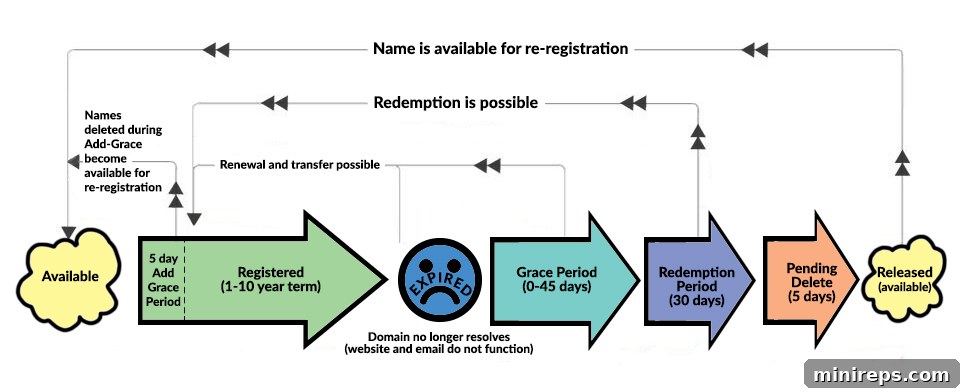
The journey of a domain name after its expiration date is a meticulously structured process, designed to offer opportunities for renewal while also ensuring that abandoned domains eventually re-enter the public pool. Neglecting your domain name renewal initiates a series of events, each with increasing repercussions for your business.
The Initial Expiration and Grace Period
Upon the official expiration date, your domain name doesn’t immediately vanish. Most domain registrars and top-level domain (TLD) registries offer an initial “grace period,” which typically lasts between 0 to 45 days. During this window, you can usually renew your domain name at the standard renewal price without incurring any additional fees. Your website and email services may or may not continue to function during this period, depending on your registrar’s policy, but the risk of disruption is high. It’s a critical time when proactive action can easily prevent future headaches.
The Redemption Grace Period: A Costly Second Chance
Should you fail to renew your domain during the initial grace period, it often enters a “redemption grace period.” This phase can last approximately 30 days, during which the domain is effectively locked by the registrar. While you can still recover your domain during this time, it comes at a significant cost. Registrars typically charge a substantial “redemption fee” in addition to the standard renewal fee, which can range from tens to hundreds of dollars. This fee covers the administrative costs associated with retrieving the domain from its pending deletion state. Ignoring this period means your domain is on a fast track to being released to the general public, where recovery becomes far more challenging and expensive.
Pending Delete and Public Release
Following the redemption grace period, if the domain remains unrenewed, it moves into a “pending delete” status. This short phase, usually around 5 days, signifies that the domain is awaiting deletion from the registry database. Once deleted, it becomes available for anyone in the world to register. This is the point of no return for easy recovery, as your ownership is completely relinquished, and the domain reverts to an unregistered status.
The World of Drop-Catching and Domain Auctions
The moment a desirable domain name becomes publicly available, it often triggers a fierce competition for its re-registration. This is where “drop-catching” services come into play. These specialized services employ sophisticated technology and high-speed servers to monitor expired domains and attempt to register them the instant they become available. Popular domains, particularly those with established traffic or SEO value, are often snapped up within milliseconds of their release, frequently destined for auction where bidders compete for ownership. The .ai domain, a favorite among startups, exemplifies this system where the registry itself often auctions off expired domains. The undeniable truth is clear: no expired domain name, regardless of its previous owner or status, is truly safe from being acquired by others once it’s released.
Critical Consequences: Why You Can’t Afford to Let Your Domain Expire
While the immediate thought might be simply losing your website, the repercussions of an expired domain name extend far deeper, touching every facet of your business operations. From critical security vulnerabilities to devastating financial and reputational damage, the costs of negligence far outweigh any perceived savings from not renewing.
1. Severe Cybersecurity Risks
The most alarming consequence of an expired domain is the profound cybersecurity risk it poses. When your domain lapses, anyone who registers it gains control not only of your web address but also potentially of your entire digital ecosystem.
Access to Linked Online Services
Many online services – from social media accounts and cloud storage to payment gateways and customer relationship management (CRM) systems – are linked to your domain-based email address. If a malicious actor acquires your expired domain, they can often set up email accounts associated with that domain. With control over your email, they can initiate password reset requests for numerous services. Many platforms, unfortunately, do not enforce two-factor authentication (2FA) by default, or users may not have it enabled, making it frighteningly easy for cybercriminals to gain unauthorized access to your critical business accounts. This includes sensitive data, financial records, and private communications.
Phishing and Impersonation
Once in control of your domain, bad actors can impersonate your brand. They might host phishing websites designed to trick your customers into revealing personally identifiable information (PII) or financial details. These fraudulent sites can look identical to your original, leading to widespread confusion and potential data breaches. The stolen information can then be sold on the black market, leading to severe legal and ethical ramifications for your business, even if you were not directly responsible for the breach.
Reputational Damage from Security Breaches
A security breach stemming from an expired domain can inflict irreparable harm on your brand’s reputation. Customers lose trust in businesses that fail to protect their data or maintain a secure online presence. Rebuilding this trust is an arduous, often years-long process, costing significant time, money, and marketing efforts. Furthermore, such breaches can lead to regulatory fines, legal liabilities, and mandatory public disclosures, further compounding the damage.

2. Significant Financial Losses
The financial ramifications of an expired domain name are immediate and extensive, impacting your bottom line through direct losses, increased operational costs, and diminished long-term investment value.
Immediate Business Downtime and Lost Sales
When your domain expires, your website and all associated online services typically go offline. This immediate downtime translates directly into lost sales, missed opportunities, and halted business operations. Customers cannot access your products, services, or information. Any ongoing marketing campaigns, whether paid advertisements or organic SEO efforts, become instantly ineffective, wasting your allocated budget and resources.
Increased Operational Costs
The absence of your website often leads to a deluge of customer inquiries and complaints, overwhelming your customer service team. Resources that would normally be focused on growth and development are diverted to crisis management, explaining the situation to frustrated clients, and attempting to mitigate damage. If you manage to recover your domain, you’ll likely incur redemption fees, potentially auction costs, and even legal expenses if a cybersquatter or competitor acquired it. History is rife with examples of even major corporations, such as The Dallas Cowboys, ending up paying thousands, or even millions, of dollars to regain control of their brand-defining domain names after accidental expiration.
Loss of Advertising and SEO Investment
Every dollar spent on building brand awareness, driving traffic through SEO, or running paid advertising campaigns becomes null and void when your domain expires. Search engines will de-index your site, causing all accumulated organic search visibility to evaporate. The extensive investment in content creation, link building, and technical SEO will effectively be lost, requiring a massive and costly effort to rebuild from scratch.

3. Irreparable Brand Reputation Damage
Your domain name is synonymous with your brand. Its disappearance or misuse can inflict long-lasting and often irreparable damage to your business’s reputation and credibility.
Loss of Trust and Credibility
When customers encounter a non-existent or compromised website, their trust in your brand is immediately eroded. If your services malfunction due to an expired domain, as was the case with Sorenson Communications, a company dealing with critical communication services, clients lose faith in your reliability and commitment. This perceived unreliability can drive customers to competitors and create a lingering negative perception that is incredibly difficult to overcome.
Brand Hijacking and Misrepresentation
An expired domain is an open invitation for brand hijacking. A competitor could acquire your domain and redirect it to their own site, effectively cannibalizing your traffic and sales. Worse, a malicious entity could use your domain to host inappropriate, misleading, or even illegal content, directly associating it with your brand. This misrepresentation not only tarnishes your image but can also lead to legal battles and public relations disasters.
Impact on Future Growth and Partnerships
A damaged reputation impacts every aspect of your business’s future. Potential clients, investors, and partners conduct due diligence by examining your online presence. A history of domain lapses or security issues signals instability and unprofessionalism, making it challenging to secure new business, attract talent, or forge valuable collaborations. Maintaining a strong, consistent online presence, often by owning multiple variations of your domain (e.g., .com, .net, country-specific domains), is crucial for establishing authority and protecting your brand across the internet. Without proper domain name management, this comprehensive portfolio can become a liability if even one key domain falls through the cracks, underscoring the vital role of a vigilant domain administrator.

4. Devastating SEO Consequences
For any business relying on organic search traffic, an expired domain is a catastrophic event that can erase years of SEO effort and significantly set back your online visibility.
Erosion of Search Engine Rankings
When your domain expires and your website becomes inaccessible, search engines like Google will quickly notice the downtime. Over time, your site will be de-indexed, meaning it will be removed from search results. All the painstaking work put into keyword optimization, content creation, and technical SEO will vanish, leading to a complete loss of your hard-earned search engine rankings. This isn’t a temporary dip; it’s a full reset.
Loss of Backlink Equity
Backlinks from other reputable websites are a fundamental pillar of SEO, signaling authority and trustworthiness to search engines. If your domain expires, all those valuable backlinks will suddenly point to a non-existent or, worse, a malicious website. This not only strips your domain of its accrued “link juice” but also means that those referring sites are now linking to a broken or potentially harmful destination, which can negatively impact their SEO too. Regaining this lost backlink equity is incredibly challenging, often requiring manual outreach and rebuilding relationships.
Rebuilding from Scratch
Even if you manage to recover your domain, or acquire a new one, the journey back to your previous SEO standing is arduous and time-consuming. Search engines treat a re-registered domain much like a new one, requiring you to essentially start your SEO efforts from scratch. This means a prolonged period of reduced organic traffic, diminished online visibility, and intense competition to regain even a fraction of your former rankings. The financial and time investment required for recovery often far exceeds the cost of simple renewal.
Proactive Strategies to Safeguard Your Domain
Given the severe consequences, preventing domain expiration should be a top priority for every business. Fortunately, there are several straightforward strategies you can implement to protect your digital assets.
Enable Auto-Renewal
The simplest and most effective defense against accidental expiration is to enable the auto-renewal feature provided by your domain registrar. Ensure that your payment information is always up-to-date and linked to a reliable payment method that won’t expire unexpectedly. This automates the renewal process, giving you peace of mind.
Maintain Accurate Contact Information
Registrars send critical renewal notifications and warnings to the contact email address listed in your domain’s WHOIS record. It is imperative to keep this information accurate and current. Use an email address that is actively monitored, ideally by multiple team members, rather than one tied to a single individual who might leave the company or neglect their inbox.
Centralized Domain Management
For businesses with multiple domain names, consolidating them under a single, reputable registrar and utilizing a corporate domain management service can streamline the renewal process. These services often provide advanced tools, dedicated account managers, and robust reporting to ensure no domain is overlooked. Appointing a dedicated domain administrator with clear responsibilities is also crucial for systematic oversight.
Multiple Reminders and Calendar Alerts
Don’t rely solely on your registrar’s notifications. Set up personal or team calendar reminders well in advance of expiration dates. Configure these alerts to trigger at 90, 60, and 30 days before renewal, ensuring ample time to address any issues or confirm renewal actions. Consider using external monitoring services that track your domain status independently.
Consolidate Domains with a Reputable Registrar
If your domains are scattered across multiple registrars, consider consolidating them with one trusted provider. This reduces administrative overhead and minimizes the chances of missing critical notifications or renewal deadlines. Choose a registrar known for its reliability, excellent customer support, and user-friendly management interface.
Conclusion: Your Domain is Non-Negotiable
Ultimately, letting your domain name expire means far more than just losing your website; it means surrendering your digital identity and exposing your business to a cascade of severe consequences. From profound cybersecurity threats that can compromise sensitive data and linked services, to significant financial losses through lost sales and costly recovery efforts, and the irreparable damage to your brand’s reputation and SEO authority, the risks are simply too great to ignore. Your domain name is a foundational asset for your business’s success and sustainability in the digital realm. We cannot emphasize enough the importance of prioritizing its renewal. Therefore, we strongly urge all business owners to regularly check their domain renewal dates, maintain accurate contact information, and most importantly, utilize automatic renewal features within your registrar account to ensure continuous protection and uninterrupted online presence.