

In the vast and ever-expanding digital landscape, domain names serve as crucial identifiers for businesses, individuals, and organizations alike. They are the gateways through which users access online content and interact with brands. However, this fundamental aspect of the internet also presents opportunities for malicious actors to exploit brand recognition for illicit gains. This practice, widely known as cybersquatting, has evolved over the years, giving rise to new and more sophisticated forms of deception. Understanding these threats is paramount for both consumers seeking to protect their personal information and brands striving to safeguard their reputation and intellectual property.
At its core, cybersquatting involves the registration of a domain name that incorporates the trademark of a well-known brand, with the explicit intent to profit from the trademark’s established likeness. This is a crucial distinction that separates legitimate domain investors from malicious cybersquatters. Domain investors leverage industry knowledge, market trends, and logical forecasting to identify and acquire domain names that possess inherent value and are likely to become desirable in the future. Their goal is long-term appreciation and a fair return on investment. In stark contrast, cybersquatters operate with a deceptive agenda, registering trademarked domains to mislead the public into believing they are associated with the legitimate brand, ultimately aiming to generate profit through this deceitful association. This malicious intent is the defining characteristic that differentiates cybersquatting from legitimate domain investment practices.
The Evolution of Online Deception: From Typosquatting to Combosquatting
Cybersquatting manifests in various forms, with one of the most recognized being typosquatting. Typosquatting relies on common keyboard errors or misspellings that users might make when typing a domain name. By registering domains like ‘gogle.com’ instead of ‘google.com’, cybersquatters aim to capture traffic inadvertently directed their way due to these typographical mistakes. While effective, this method often relies on simple human error.
However, the landscape of online threats is constantly evolving. A groundbreaking study conducted collaboratively by Georgia Tech, Stony Brook University, and South Bank University has shed light on a significantly more advanced and insidious form of cybersquatting, which they term “combosquatting.” Combosquatting represents a sophisticated evolution, where malicious actors register domain names that ingeniously combine a popular, recognizable trademark with an additional string of words or phrases. These appended words often seem plausible or innocuous, making the overall domain appear legitimate at first glance.
The study meticulously analyzed how these combosquatting domain names were being utilized, uncovering alarming statistics. Their comprehensive analysis revealed that a staggering 88.77% of these domains exhibited suspicious activity, with 13.39% being outright malicious. These figures underscore the pervasive and dangerous nature of combosquatting, highlighting its significant threat to both individual internet users and established brands. The clever combination of a trusted trademark with seemingly relevant keywords creates a potent deceptive tool, making it increasingly difficult for unsuspecting users to distinguish between genuine and fraudulent websites.
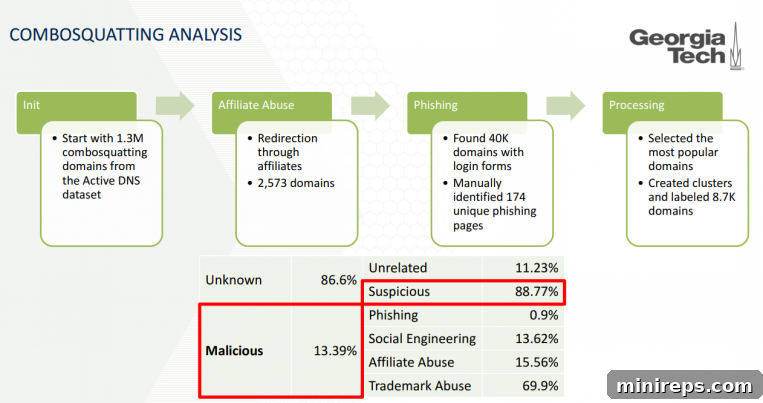
Image Source: Georgia Tech
Combosquatting: A Dual Threat to Consumers and Brands
Combosquatting poses a grave and multifaceted threat, impacting both unsuspecting consumers and the brands whose identities are being exploited. For consumers, the primary danger lies in the high probability of falling victim to phishing attacks and malware distribution. Many combosquatting domains are meticulously crafted to serve as gateways for phishing tactics, designed to trick users into divulging sensitive personal and financial information.
Consider a common scenario: you might receive an email that appears to originate from your bank. Within this email, there’s a link that, upon closer inspection, leads to a website like bankofamerica-com-login-sys-update-online.com. Because you instantly recognize “Bank of America” within the domain name, your guard may be lowered. The additional words “login,” “sys-update,” and “online” might even lend an air of legitimacy, suggesting a routine security procedure. Trusting this seemingly authentic link, you proceed to input your private login credentials, account numbers, or other sensitive data. Unbeknownst to you, this information is immediately transmitted to the malicious actors behind the combosquatting domain, who are now poised to exploit your trust for financial gain, identity theft, or other nefarious purposes. The insidious nature of combosquatting lies in its ability to leverage existing brand trust to circumvent user caution.
Another prevalent tactic employed by hackers using combosquatted domains involves the deployment of deceptive update and password credential pop-ups. These pop-ups are often designed to mimic legitimate system dialogues or brand alerts, creating a sense of urgency and necessity. For instance, a domain like airbnbforbeginners.com, while seemingly innocent and potentially offering beginner tips for Airbnb users, could host such malicious pop-ups. Someone familiar with the legitimate Airbnb brand, perhaps looking for user guides or support, would be highly susceptible to believing a fake “account upgrade” or “password verification” pop-up originating from such a domain. These deceptive prompts are not merely after your login details; they can also be used to trick you into downloading malware or viruses, which can compromise your entire system, grant unauthorized access to your accounts, or even encrypt your data for ransomware attacks.
This tactic is particularly common with services like Apple iTunes and iCloud. Users might encounter seemingly legitimate pop-up messages while browsing the web or using an app, instructing them to enter their Apple ID credentials for verification or an update. Our smart devices have, to some extent, conditioned us to blindly comply with requests for credentials, especially when presented within a familiar interface. This learned behavior makes users highly vulnerable to combosquatting attacks. If you ever encounter such a message randomly popping up, it is crucial to dismiss it immediately. Instead, always navigate directly to the legitimate Settings application on your device and enter your credentials there if prompted. If the system still requires you to log in through the official settings, then it is a legitimate system dialogue. Exercising critical thinking and vigilance regarding the websites and pop-ups you trust is no longer just good practice; it is an essential defense against this evolving form of cybersquatting.
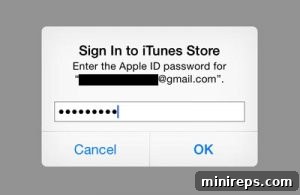
Image Source: igeeksblog
Protecting Your Brand from Combosquatting and Cybersquatting
For brands, the consequences of cybersquatting, particularly combosquatting, extend far beyond individual consumer deception. It poses a significant threat to brand equity, reputation, and customer trust. When a customer is fooled by a fraudulent domain and website that they believe belongs to your brand, and subsequently experiences issues such as a product not arriving, financial loss, or identity theft, their blame will not be directed at an unknown cybersquatter. Instead, they will feel let down by your brand, leading to erosion of loyalty, negative reviews, and potential legal repercussions. This dilution of your brand name can take years to repair and can inflict lasting damage on your market standing.
Proactive brand protection strategies are therefore indispensable in today’s digital environment. Here are top tips for brands to safeguard their online presence and customer relationships:
- Implement Comprehensive Brand and Trademark Monitoring Services:
Brand and trademark monitoring services are indispensable tools in the fight against cybersquatting. These specialized services take on the demanding and often overwhelming task of continuously scanning the internet for unauthorized uses of your brand name and trademarks. They diligently monitor newly registered domain names across all top-level domains (TLDs), social media platforms, and online marketplaces for potential infringements. By proactively identifying instances of domain name and trademark hijacking, these services enable brands to take swift action, such as issuing cease and desist letters, filing Uniform Domain-Name Dispute-Resolution Policy (UDRP) complaints, or initiating legal proceedings. They also play a crucial role in enforcing action against counterfeit websites, phishing campaigns, and other deceptive online content, thereby actively maintaining and bolstering your overall brand reputation and integrity online. Outsourcing this complex and time-consuming task to experts ensures consistent and thorough protection.
- Utilize Defensive Domain Registrations:
Defensive registrations offer a proactive and highly effective solution for trademark owners. This strategy allows brands to preemptively block their trademarks across a specified range of domain endings, particularly within new gTLDs (generic Top-Level Domains) where many cybersquatting attempts occur. Rather than waiting for an infringement to happen, defensive registrations secure common misspellings, variations, or keyword combinations related to your brand. For example, a well-known brand like Facebook effectively utilizes defensive registrations by securing domain names such as fasebook.com and facbook.com. Both of these defensively registered domains automatically redirect to the official facebook.com website, ensuring that any user who inadvertently types a common misspelling is still guided to the legitimate site. This approach ensures that none of your website visitors are diverted to malicious or competing platforms, thereby preserving traffic, maintaining brand control, and enhancing user trust. It is a vital proactive measure against various forms of cybersquatting, including typosquatting and combosquatting.
- Adopt Strategic Domain Usage for Marketing Campaigns:
When planning new marketing campaigns or launching specific initiatives, it is critical to rethink the use of your trademark within new domain names. If your brand utilizes a combination of your trademark and common words—similar to the structure of combosquatting domains—it creates ambiguity for consumers. They will find it exceedingly difficult to distinguish between your legitimate campaign domains and malicious combosquatting attempts. This confusion can inadvertently make your customers more vulnerable to scams. Instead, we strongly suggest leveraging the new domain endings (gTLDs) that have emerged in recent years for your marketing campaigns. For example, a brand like Amazon could effectively use domains such as Amazon.sale, Amazon.marketing, or Amazon.social. These new gTLDs provide clear context and create distinct, trustworthy online spaces for specific campaigns without confusing the brand’s core identity. This strategy not only enhances clarity for consumers but also allows for innovative branding opportunities while simultaneously bolstering your overall digital security posture against deceptive practices.
The digital landscape is a dynamic environment, and the threats within it are constantly evolving. Waiting for an incident to occur before implementing protective measures is a reactive and often costly approach. By being proactive in your domain management and embracing robust brand protection strategies, you can significantly mitigate the risks posed by cybersquatting and combosquatting. Protect your trademarks, secure your online presence, and, most importantly, safeguard the trust and loyalty of your valued customers. Vigilance and strategic planning are your strongest allies in the ongoing battle for online integrity.