


In the fast-paced digital era, a domain name is far more than just an address; it’s your brand’s cornerstone, digital identity, and a crucial asset for online visibility. Yet, despite its importance, countless domain names lapse into expiration every day, creating a lucrative opportunity for a specialized industry: domain drop catching. This practice involves savvy individuals and organizations “snatching” up expired domain names the very moment they become available for public registration. For businesses, the loss of a mission-critical domain can lead to severe operational disruptions, financial setbacks, and irreparable brand damage. Understanding the dynamics of domain drop catching is essential for safeguarding your digital assets and ensuring the longevity of your online presence. This comprehensive guide will shed light on why domains expire, what happens during the expiry process, who the key players in the drop-catching world are, and crucially, how you can prevent or recover from such an ordeal.
Why Do Mission-Critical Domain Names Expire? A Look at Common Pitfalls
It might seem unfathomable that a business or individual could allow a vital domain name to expire, especially one central to their operations. However, this oversight occurs with surprising frequency, often due to a combination of human error and systemic vulnerabilities. While domain registrars offer convenient features like auto-renewal and the option to register domains for up to ten years, domains still fall through the cracks. The reasons are varied and highlight the importance of robust domain management strategies.
Common culprits behind domain expiration include:
- Procrastination: The “I’ll do it later” mentality can be a domain owner’s worst enemy. Delaying renewal decisions, questioning the domain’s long-term value, or simply putting off administrative tasks often leads to missed deadlines.
- Forgetfulness: Many individuals and even businesses manage multiple domains, often across different registrars. Losing track of where a domain is registered, which email was used for registration, or the specific expiry date can easily lead to accidental expiration.
- Ignoring Renewal Emails: Registrars typically send multiple email reminders as an expiration date approaches. However, these emails can be overlooked, dismissed as spam, or simply ignored amidst a cluttered inbox, leading to critical warnings going unheeded.
- Email Deliverability Issues: Sometimes, the problem isn’t the owner’s oversight but rather the registrar’s. Poor email deliverability, outdated contact information, or aggressive spam filters can prevent essential renewal notifications from reaching the domain owner. Ensuring your contact details are always current and whitelisting your registrar’s email addresses are crucial steps.
- Disabling Auto-Renew: While auto-renewal is a powerful tool for domain retention, some owners opt to disable it, preferring manual control. This often stems from a misplaced confidence in remembering renewal dates, which, more often than not, proves to be a costly gamble.
- Insufficient Funds or Expired Payment Methods: Auto-renewal is only effective if the payment method on file is valid. Expired credit cards, changed bank accounts, or insufficient funds can lead to auto-renewal failures, leaving the domain vulnerable without immediate notification to the owner.
- Staff Turnover and Lack of Succession Planning: In organizational settings, the departure of a key employee responsible for domain management can leave critical renewal tasks unassigned and forgotten. Without clear succession plans or centralized domain control, valuable assets can be lost during transitional periods.
- Mergers and Acquisitions: During complex corporate restructuring, domains associated with acquired entities can sometimes be overlooked in the due diligence process, leading to accidental expiration if not properly transferred and integrated into the new entity’s management system.
To mitigate these risks and safeguard your digital presence, we strongly advocate for extending your domain term to the maximum allowable years. While the upfront cost might be slightly higher, perhaps $100-$200 today, this investment provides invaluable peace of mind and drastically reduces the chances of an accidental expiration, which could potentially cost your business seven figures in lost revenue and recovery expenses down the road.
Expert Advice: How to Optimize Your Domain Administration
Discover essential strategies for setting up your domain administration for success. Learn critical insights such as who should be listed as the domain owner and the paramount reasons why you should never entrust a third-party with registering a domain on your behalf.
The Domain Lifecycle: What Happens When Your Domain Name Expires?
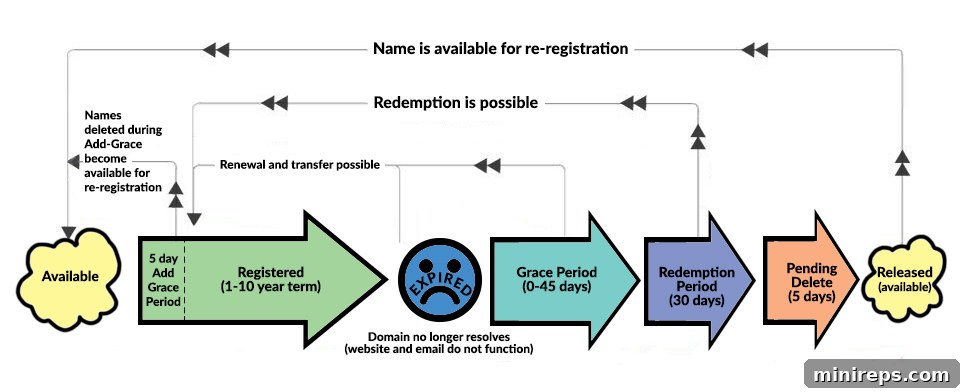
Understanding the domain lifecycle is crucial for protecting your digital assets. While specific policies can vary slightly between different top-level domains (TLDs) and registrars, the general progression of an expired domain follows a predictable path. Each stage presents a narrowing window of opportunity for the original owner to reclaim their property.
Here’s a breakdown of the typical domain expiration process:
- Active Status: This is the normal state of a registered domain. It is fully functional, pointing to your website, handling emails, and serving all its intended purposes.
- Expiration and Grace Period (Day 0 – ~30-45 days post-expiration): Once the registration term ends, the domain technically expires. Most domain registries and registrars offer a “grace period,” typically lasting between 0 and 45 days. During this time, the domain owner can usually renew the domain at the standard renewal price without any penalties. However, your website and email services may become inactive immediately upon expiration, leading to service disruption and potential brand damage. It is paramount to renew during this phase.
- Redemption Period (~30-45 days to ~60-75 days post-expiration): If a domain is not renewed during the grace period, it typically enters a “redemption period,” which commonly lasts for 30 days. During this phase, the domain can still be recovered by the original owner, but it comes with an associated “redemption fee” in addition to the standard renewal cost. This fee can be substantial, often ranging from $100 to $250 or even more, making it a costly last-ditch effort to reclaim the domain.
- Pending Deletion (~60-75 days to ~65-80 days post-expiration): Following the redemption period, the domain enters a “pending deletion” status, which usually lasts for about 5-7 days. During this brief window, the domain is no longer renewable by the previous owner, and it cannot be transferred. It is essentially in a queue to be purged from the registry database.
- Dropped / Public Release (~65-80 days post-expiration): After the pending deletion period, the domain is officially deleted from the registry and released to the general public. At this precise moment, it becomes available for anyone to register, marking the critical point where domain drop catchers, using sophisticated systems, attempt to acquire it. Once a domain reaches this stage and is registered by another party, recovering it becomes significantly more challenging and expensive for the original owner.
RELATED ARTICLE: Understand the Risks: 3 Critical Consequences of Letting Your Domain Names Expire
The World of Domain Drop Catching: Who Are the Players?
Domain drop catching has evolved into a formidable industry, with significant financial implications for both those seeking to acquire valuable domains and those trying to recover them. Whether you’re a business aiming to acquire a highly sought-after domain name or a company desperately attempting to recover a domain you accidentally let expire, it’s crucial to understand who you’re up against: the domain investors.
The vast majority of dropped domain names, especially those with inherent value, are quickly snapped up by domain investors, often referred to as “domainers.” These individuals and businesses have built entire livelihoods around acquiring, holding, and reselling (or “flipping”) valuable expired domains. They operate with a level of sophistication far beyond manual observation. Domain investors employ cutting-edge algorithms and high-speed bidding systems to constantly monitor the tens of thousands of domains expiring daily across various registries. Their technology allows them to sift through this enormous volume, identifying domains that meet specific criteria:
- Dictionary Terms: Domains containing common words or phrases are highly valuable for branding and search engine optimization (SEO).
- Acronyms and Short Names: Memorable, concise domains are always in demand.
- Traffic and Backlink Profile: Many expired domains still retain valuable organic search traffic and a strong backlink profile from their previous owners. Investors understand that this “SEO juice” can be highly leveraged or sold at a premium.
- Brandability: Domains that are easy to remember, pronounce, and suitable for a broad range of businesses.
- Specific TLDs: Premium TLDs like .com, .org, and .net are often prioritized, though new gTLDs are also gaining traction.
When an original domain owner attempts to recover their lost domain, they are often surprised by the asking price. It’s important to realize that a domain investor isn’t going to accept a token offer like $1,000 for a genuinely valuable asset. These investors perform extensive due diligence when acquiring a domain, considering numerous factors that dictate its market value:
- Existing Traffic and Backlinks: Domains with established search engine rankings and quality backlinks are goldmines, as they offer immediate SEO benefits to a new owner.
- Versatility and Broad Appeal: A domain that can be used across multiple industries or business types commands a higher price.
- Previous Ownership and History: If the domain was previously owned by a well-known company or had a reputable history, its brand equity carries significant weight.
- Keyword Relevance: Domains that perfectly match high-volume search keywords are highly prized.
- Length and Memorability: Shorter, easier-to-remember domains are generally more valuable.
- Brand Value: The intrinsic value of the domain as a brand in itself.
The domain secondary market, where these transactions occur, is robust and often opaque to outsiders. Investors leverage their expertise and resources to secure these assets, turning a potential loss for one party into a significant gain for another. This intricate ecosystem underscores the critical need for proactive domain management and brand protection strategies for all organizations.
True Story: A Multimillion-Dollar Domain Loss
In 2007, Parker Hannifin, a multi-billion dollar corporation, acquired Rectus and its subsidiary Tema, along with the highly valuable domain name tema.com. After years of diligent renewal, Parker Hannifin inadvertently allowed the domain to expire in 2020. This critical oversight resulted in the domain being auctioned off at DropCatch.com, where it ultimately fetched a staggering $128,938, demonstrating the immense financial implications of accidental domain expiration for even the largest enterprises.
Protecting Your Digital Identity: Proactive Measures to Prevent Domain Expiration
Given the significant risks and costs associated with domain expiration and subsequent drop catching, prevention is undeniably the best strategy. Implementing robust domain management practices can save your business from immense headaches, financial loss, and brand erosion. Here are essential proactive measures every domain owner should adopt:
- Enable Auto-Renewal with Up-to-Date Payment Info: This is the simplest and most effective defense. Always have auto-renewal enabled for all critical domains. Crucially, ensure the credit card or payment method on file is current and has sufficient funds. Regularly check its expiry date and update it promptly.
- Register for the Maximum Term: Whenever possible, register or renew your domain for the maximum allowable period (typically 10 years). This significantly reduces the frequency of renewal notifications and minimizes opportunities for oversight.
- Centralize Domain Management: Avoid scattering your domains across multiple registrars or under different accounts. Consolidate your portfolio under a single, reputable registrar and a dedicated management account. This provides a unified dashboard for all expiry dates and administrative tasks.
- Maintain Accurate and Redundant Contact Information: Ensure your WHOIS contact details (Registrant, Administrative, Technical) are always accurate and up-to-date. Use reliable email addresses that are actively monitored and consider listing secondary contact emails, perhaps from a different provider, as a backup.
- Whitelist Registrar Communications: Add your domain registrar’s email addresses to your safe sender list or contacts to prevent renewal notices and critical alerts from being trapped by spam filters.
- Implement Domain Locks: Most registrars offer a “registrar lock” feature. This lock prevents unauthorized transfers of your domain name to another registrar, adding an extra layer of security against malicious attacks or accidental transfers.
- Regularly Audit Your Domain Portfolio: Schedule periodic reviews (e.g., quarterly or semi-annually) of your entire domain portfolio. Verify expiry dates, contact information, and auto-renewal settings.
- Utilize Domain Monitoring Services: Consider subscribing to third-party domain monitoring services. These services can track your domain’s status, alert you to impending expirations, or notify you of any unauthorized changes.
- Develop Internal Domain Management Policies: For businesses, establish clear internal protocols for domain ownership, renewal responsibilities, and access credentials. Designate primary and secondary contacts for all domains, ensuring continuity even with staff turnover.
- Implement Multi-Factor Authentication (MFA): Protect your registrar account with MFA to prevent unauthorized access, even if your password is compromised.
By adopting these proactive strategies, you significantly reduce the vulnerability of your domain names to accidental expiration and the opportunistic hands of drop catchers, ensuring the continuous operation and integrity of your online presence.
What to Do If You Lose Your Domain Name to a Drop Catcher?
Even with the best preventative measures, sometimes a critical domain can still slip through the cracks and fall into the hands of a drop catcher. While prevention is always paramount, understanding your options for recovery is essential. The process can be challenging, costly, and often requires expert intervention.
Here’s a breakdown of steps and considerations:
- Act Immediately (If in Grace/Redemption Period): If you realize your domain has expired but is still within the grace or redemption period, act without delay. Renew it through your registrar immediately, understanding that a redemption fee will likely apply if you are past the grace period. This is your easiest and most cost-effective recovery option.
- Identify the New Owner (If Dropped): Once a domain has been dropped and registered by a drop catcher, the first step is to identify the new registrant. Perform a WHOIS lookup for the domain. This will provide information about the new owner and their registrar, though privacy protection services might mask direct contact details.
- Negotiation and Acquisition:
- Direct Negotiation: You can attempt to contact the new owner directly to negotiate a purchase. Be prepared for a significantly higher price than your original renewal fee. Domain investors are astute businesspeople; they know the value of the asset they hold and will likely demand a premium based on factors like the domain’s brand equity, SEO value, and your apparent urgency.
- Using a Domain Broker: For high-value domains, or if you prefer to remain anonymous during negotiations, consider using a professional domain broker. Brokers have experience in this niche market, can help determine a fair market value, and negotiate on your behalf, often achieving a better outcome and maintaining your anonymity.
- Legal Recourse (UDRP): In certain situations, if the drop catcher has registered your domain in “bad faith” and it infringes upon an existing trademark you own, you may have grounds for a Uniform Domain-Name Dispute-Resolution Policy (UDRP) complaint. This is a legal process, typically handled by arbitration panels, to force the transfer of the domain back to the rightful trademark owner. However, UDRP cases are complex, time-consuming, expensive, and require strong evidence of trademark infringement and bad faith registration. It is not applicable for general cases of accidental expiration.
- Rebranding: As a last resort, if recovery proves impossible or prohibitively expensive, you might be forced to consider rebranding and moving to a new domain name. This is often the most costly option, involving significant efforts to update all marketing materials, rebuild SEO authority, inform customers, and potentially lose existing traffic and brand recognition.
Navigating the aftermath of losing a domain to a drop catcher can be incredibly complex. For businesses facing this challenging situation, expert guidance is invaluable. Our Corporate Brand Team, comprised of industry veterans and experienced negotiators, specializes in digital asset recovery. We offer tailored advice and strategic guidance to help you assess your options, engage in effective negotiations, and maximize your chances of recovering your critical digital assets.
For more information about our enforcement services and how we can assist you, please contact us:
+1.888.982.7940