
In today’s rapidly evolving global economic landscape, businesses worldwide are grappling with unprecedented challenges. Inflationary pressures, widespread layoffs, and stringent budget cuts have become common narratives across industries. This precarious environment inadvertently creates fertile ground for cybercriminals, who exploit vulnerabilities as companies prioritize cost-saving measures over robust security protocols. Now, more than ever, optimizing business operations must go hand-in-hand with fortifying your digital defenses, especially against pervasive threats like email spoofing and impersonation attacks. Email, often considered the backbone of corporate communication, has become a primary vector for cyberattacks, making its security non-negotiable. This comprehensive guide will equip you with actionable strategies to significantly enhance your email performance, safeguard your brand reputation, and protect your enterprise from potentially devastating financial and operational losses due to sophisticated email-based threats.
Understanding the Threat: What Is Email Spoofing?
As digital transformation accelerates and an ever-increasing number of transactions and communications occur online, cybercriminals are presented with immense financial incentives to compromise user accounts and exploit corporate trust. Email spoofing stands as one of their most effective tactics. But what exactly does email spoofing entail? In essence, it’s the malicious act of forging an email header so that the message appears to originate from a legitimate source, such as your company, a trusted partner, or even a senior executive. The goal is to deceive recipients into believing the email is authentic, thereby manipulating them into performing actions that serve the attacker’s agenda.

Email is alarmingly easy to spoof due to fundamental aspects of its underlying protocols. Attackers can simply alter the “From” address to display a familiar name or domain, tricking email clients and recipients. Sophisticated phishers often enhance these deceptive emails by incorporating authentic company logos, branding elements, and even registering visually similar domain names – known as homograph attacks – to create an illusion of legitimacy. These tactics are designed to exploit users’ trust in well-known brands, making them vulnerable to sharing sensitive information like passwords, bank account details, or credit card numbers. The consequences extend beyond individual data theft; businesses suffer reputational damage, customer churn, and significant financial losses. If your email security measures are not rigorously maintained, your organization becomes an easy target for these pervasive and costly attacks.
Fortifying Your Defenses: Strengthening Email Security Through DNS Protocols
To effectively combat email spoofing and impersonation, every organization that sends emails must implement a foundational set of email security protocols. These essential acronyms – SPF, DKIM, and DMARC – form a robust defense system that authenticates email senders and protects recipients from fraudulent messages. If these terms are new to your security vocabulary, now is the critical moment to understand and integrate them into your corporate infrastructure.
SPF: Sender Policy Framework
Sender Policy Framework (SPF) is designed to combat sender address forgery by verifying the sender’s identity during email transmission. At its core, SPF allows domain owners to specify which mail servers are authorized to send email on behalf of their domain. This authorization is recorded in an SPF record, which is a simple TXT record published in your Domain Name System (DNS). When a receiving mail server gets an email, it checks the sending server’s IP address against the SPF record published for the purported sender’s domain. If the IP address is not listed as an authorized sender, the SPF authentication fails. This mechanism acts as a first line of defense, significantly reducing the chances of unauthorized senders successfully spoofing your domain.
DKIM: DomainKeys Identified Mail
DomainKeys Identified Mail (DKIM) provides another layer of authentication by cryptographically verifying the sending email domain and ensuring message integrity. When an email is composed and sent from a DKIM-enabled server, a unique digital signature is generated and attached to the email header. This signature is created using a private key held by the sending domain. The corresponding public key is published in the domain’s DNS records. Upon receiving the email, the recipient’s mail server retrieves the public key from the DNS and uses it to verify the digital signature. A successful verification confirms two crucial things: first, that the email indeed originated from the claimed sending domain, and second, that the message content has not been tampered with or modified during its transit from sender to recipient. DKIM is vital for preventing man-in-the-middle attacks and ensuring the authenticity of your communications.
DMARC: Domain-based Message Authentication, Reporting, and Conformance
DMARC (Domain-based Message Authentication, Reporting, and Conformance) builds upon the foundations laid by SPF and DKIM, providing a comprehensive framework for email authentication. DMARC instructs receiving mail servers on how to handle emails that fail SPF or DKIM authentication checks, thereby empowering domain owners with control over their email deliverability and security. By publishing a DMARC policy as a TXT record in your DNS, you can specify one of three actions for unauthenticated messages: ‘none’ (monitor only), ‘quarantine’ (send to spam/junk folder), or ‘reject’ (block outright). Crucially, DMARC also enables domain owners to receive aggregated reports from participating email receivers, offering invaluable insight into email traffic, authentication results, and potential spoofing attempts against their domain. This reporting mechanism is key to understanding and continuously improving your email security posture.
The Indispensable Role of DMARC in Modern Email Security
In an era where distinguishing between a legitimate email and a sophisticated fake is increasingly difficult for the average user, DMARC emerges as an essential protocol. Even advanced email providers struggle to accurately filter genuine messages from malicious spam or phishing attempts without clear guidance, often erring on the side of caution by sending suspicious emails to the spam folder or blocking them entirely. This ambiguity can lead to legitimate emails failing to reach their intended recipients, diminishing the effectiveness of marketing campaigns, customer service communications, and critical business correspondence.
Many companies operate without a full understanding of the vulnerabilities in their email authentication practices. Without DMARC, it’s virtually impossible to ascertain the full scope of legitimate messages that fail authentication and consequently fail to be delivered. Even more concerning is the lack of visibility into the sheer volume of fraudulent emails impersonating their brand that successfully make their way into end-users’ inboxes. Such blind spots are dangerous, exposing both the brand and its customers to significant risk.
DMARC provides the crucial missing link by fostering collaboration between email senders and receivers. It enables domain owners to explicitly communicate their email authentication infrastructure and policies to receiving mail servers. This shared intelligence empowers email providers to make informed decisions about whether a given message genuinely originates from the stated sender. By clearly defining how unauthenticated emails should be handled (e.g., monitored, quarantined, or rejected), DMARC dramatically improves email deliverability for legitimate communications while simultaneously creating a formidable barrier against spoofing, phishing, and impersonation. This process not only safeguards users from costly abuse but also vigorously protects the sending brand’s reputation and financial stability.
How DMARC Works to Protect Your Email Ecosystem
The operational power of DMARC lies in its ability to synthesize the authentication results from SPF and DKIM and then dictate a precise action based on a predefined policy. When a DMARC-compliant receiving mail server receives an email, it first performs SPF and DKIM checks. It then assesses whether these authentications align with the “From” address visible to the end-user (known as identifier alignment). If both SPF and DKIM pass and align, the email is considered legitimate and delivered as intended. However, if either SPF or DKIM fails, or if they pass but do not align correctly, the DMARC policy comes into play.
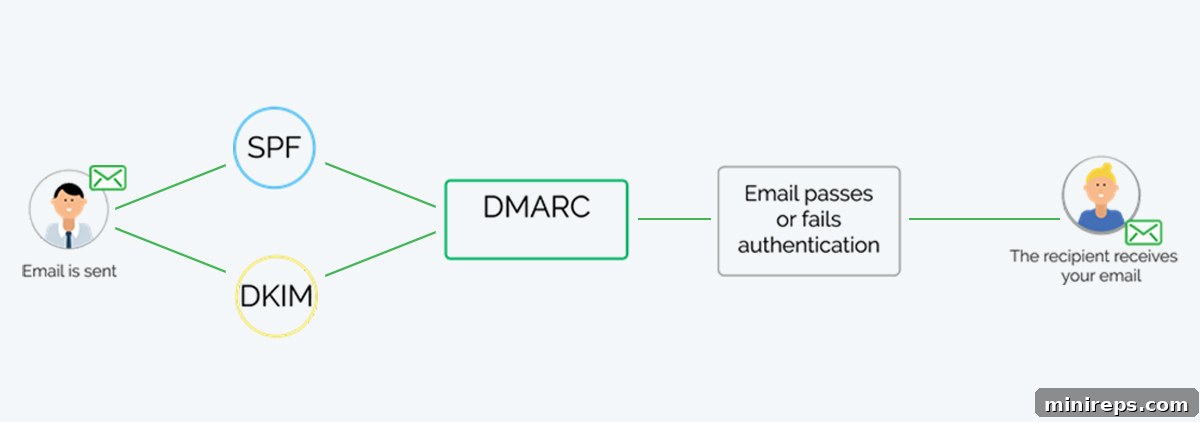
The domain owner’s DMARC policy, published in their DNS record, specifies how receiving servers should treat unauthenticated emails. A ‘p=none’ policy means the receiver should simply monitor and report on failures without taking any punitive action – ideal for initial deployment. A ‘p=quarantine’ policy instructs the receiver to place the unauthenticated email into the recipient’s spam or junk folder. The most stringent policy, ‘p=reject’, tells the receiver to outright block and reject any email that fails DMARC authentication. This empowers brand owners to prevent fraudulent and deceptive emails from ever reaching their customers’ inboxes, thereby eliminating the risk of scams and protecting their brand’s integrity. Furthermore, DMARC’s reporting functionality provides continuous feedback loops, delivering valuable XML reports (aggregate reports) to the domain owner detailing who is sending emails on their behalf, the authentication success rates, and the sources of fraudulent attempts. This data is critical for refining policies and quickly identifying new threats.
Multifaceted Benefits of DMARC for Your Business
Implementing DMARC extends far beyond basic email authentication; it provides deep, actionable insights into your entire email infrastructure. This includes not only emails sent directly from your own servers but also those dispatched on your behalf by third-party services like CRM platforms, marketing automation tools, or transactional email providers. Crucially, DMARC also uncovers and reports on malicious attacks targeting your domain or brand by cybercriminals. The advantages of DMARC are profound and wide-ranging:
Comprehensive Feedback and Visibility: DMARC enables you, as the domain owner, to gather crucial feedback regarding messages using your domain. This includes legitimate messages, those potentially mislabeled as fraudulent, and, most importantly, actual fraudulent messages. This unparalleled visibility allows you to identify unauthorized senders and correct any misconfigurations in your legitimate sending infrastructure.
Performance Monitoring: Gain critical insights into your email traffic, specifically how much of your sent mail is successfully passing and failing email authentication checks (SPF, DKIM, and DMARC alignment). This data empowers you to fine-tune your configuration, ensure all legitimate sources are properly authenticated, and mitigate issues affecting deliverability.
Policy Enforcement: You gain the power to dictate how receiving mail servers should handle messages that fail authentication. Whether you choose to request that such messages are merely reported, quarantined (sent to spam), or outright rejected, DMARC gives you unprecedented control over your domain’s email security posture.
Enhanced Brand Protection: DMARC actively stops cybercriminals from successfully impersonating your brand and domain. The detailed failure reports you receive can significantly expedite the process of identifying and taking down phishing sites and malicious campaigns, preserving your brand’s integrity and customer trust.
Improved Email Deliverability: By clarifying your email authenticity, DMARC actively helps improve your email deliverability rate. Email service providers are more likely to trust and deliver messages from domains with robust DMARC policies, ensuring your important communications reach their intended recipients without being flagged as spam.
Enhanced User Protection: Ultimately, DMARC significantly benefits the end-user – your customer. By making it unequivocally clear to their mailbox provider (like Gmail, Outlook, or Yahoo) which emails are authentic, DMARC drastically reduces the chances of spam and phishing messages ever reaching their inbox, fostering a safer digital environment for everyone.
Simplified DMARC Implementation with 101domain Managed DMARC
Considering the extensive benefits of deploying robust DMARC email authentication, the decision to implement it is a clear strategic imperative for any forward-thinking business. However, despite its crucial role, the technical intricacies of configuring, deploying, and continuously monitoring DMARC can be incredibly complex and time-consuming without specialized expertise. Misconfigurations can inadvertently lead to legitimate emails being blocked, causing significant business disruption. This is where 101domain’s Managed DMARC services become invaluable, making the path to DMARC compliance swift, secure, and effortlessly managed.
101domain’s streamlined 4-step process to DMARC compliance ensures comprehensive protection without the hassle:
- Initial Assessment and Complimentary Report: Your journey begins with a complimentary, in-depth report. This essential first step provides a clear snapshot of your email domain’s current activities, identifying all sending sources and revealing your existing DMARC posture, highlighting any vulnerabilities or misconfigurations.
- Expert Configuration and Free Trial: Following the assessment, you can sign up for a free trial. Our dedicated 101domain solutions engineers will meticulously configure SPF, DKIM, and DMARC records for all your legitimate email sources. This ensures every authorized sender is properly authenticated, laying a solid foundation for your email security.
- Phased Policy Deployment and Data Collection: Leveraging our advanced OnDMARC platform, we commence data collection, providing real-time visibility into your email traffic. We then strategically move your DMARC policy from ‘none’ to ‘quarantine’ and finally to ‘reject’ in carefully managed steps. This phased approach is critical to ensuring that legitimate emails are never inadvertently rejected, while progressively enhancing protection against spoofing.
- Continuous Monitoring and Ongoing Protection: Once DMARC is fully deployed and operating at its optimal ‘reject’ policy, our commitment doesn’t end. We provide continuous monitoring for new email sources and potential anomalies, guarding against evolving attack vectors. This proactive vigilance ensures your brand remains protected, and your email deliverability consistently high.
Customers and companies globally are increasingly vulnerable to the relentless tide of spam and sophisticated phishing attacks that plague the internet. You don’t have to become another victim of fraudulent emails that tarnish your brand and undermine your communications. By taking proactive control of your email security infrastructure with DMARC, you eliminate the risk of wasting valuable marketing dollars on email campaigns that may never reach your customers’ inboxes. DMARC not only guarantees that your legitimate emails are delivered reliably but also steadfastly protects your brand reputation from malicious impersonation. Elevate your email security posture and ensure your digital communications are both trusted and delivered.
Speak with a dedicated email security expert today to learn how to get started with OnDMARC and secure your domain. Call us at +1.888.982.7940 or visit our website.