
In today’s hyper-connected digital landscape, securing the perfect domain name is paramount for any aspiring business, personal brand, or innovative startup. For decades, the ubiquitous .com domain reigned supreme, becoming synonymous with online presence. However, as the internet expanded, so did the demand for memorable, concise, and brand-relevant web addresses. The harsh reality for many is that the vast majority of desirable .com domains were registered decades ago, leaving new entrants struggling to find a name that truly resonates.
This challenge has paved the way for an exciting new frontier in domain selection: the rise of alternative Top-Level Domains (TLDs). Among these, a special category of country code Top-Level Domains (ccTLDs) has emerged, offering fresh opportunities for branding and identity. You’ve likely encountered them: the trendy .me, the media-centric .tv, the gaming powerhouse .gg, and the undeniably hot .ai. These aren’t just obscure regional extensions; they are globally recognized digital assets.
At first glance, one might assume these are merely country-specific domains. For instance, if .ai technically belongs to Anguilla, a tiny Caribbean island, a natural question arises: “Will Google limit my website’s visibility, only showing it to people within that specific region?” This concern is valid for most traditional ccTLDs. However, for a select group, the answer is a resounding “No,” and this exemption is due to a crucial designation: the Generic Country Code Top-Level Domain (gccTLD).
Unveiling the Power of gccTLDs: What Makes a Domain Generic?
To truly understand the unique advantage of gccTLDs, it’s essential to first grasp the traditional function of country code domains. The vast majority of ccTLDs, such as .ca for Canada or .fr for France, are inherently “territorial.” This means that when a website utilizes a .ca domain, search engines like Google instinctively interpret its content as primarily intended for a Canadian audience. Similarly, a .fr domain signals relevance to users in France, directly impacting how and where that website appears in search results.
However, the internet is a dynamic, evolving space where usage often transcends original intentions. Every once in a while, a specific country code domain transcends its geographical boundaries and gains immense global popularity. This phenomenon typically occurs when a ccTLD’s letters coincidentally align with a globally recognized term or concept, or when a small nation strategically markets its domain for international use. A prime example is .tv, originally the ccTLD for the island nation of Tuvalu. As video content and streaming platforms began to dominate the web, the “tv” extension became an obvious and intuitive choice for sites related to television, media, and digital video, far beyond Tuvalu’s shores.
Google, as the world’s leading search engine, closely monitors these usage patterns. Recognizing that these particular ccTLDs were no longer exclusively serving their home countries but were adopted as general-purpose extensions by a global audience, Google made a strategic decision. It created a “Generic” category for these country codes, thus coining the term g-ccTLD (Generic Country Code Top-Level Domain). This designation is essentially Google’s official acknowledgment: “We understand that while this domain technically originates from a specific country, its practical application and global perception have transformed it into a universal domain extension, much like .com or .org.” This acknowledgment is a game-changer for businesses and individuals seeking a distinct and globally relevant online identity.
SEO Implications: Breaking Free from Geotargeting Constraints
The distinction between a standard ccTLD and a gccTLD carries significant weight for your Search Engine Optimization (SEO) strategy. Under normal circumstances, websites using territorial country code domains are subject to “geotargeting.” This means Google’s algorithms work to match the website with a local audience, prioritizing its visibility in search results for users within that domain’s associated country. While beneficial for purely local businesses, this can severely limit the global reach of an international brand or a startup aiming for worldwide recognition.
However, with a gccTLD, this restrictive geotargeting is effectively lifted. Google Search Console stops automatically geotargeting your website to a specific country. Instead of being tethered to one particular nation, your site is treated as location-independent. This is a crucial advantage, as it means your website possesses the same global ranking potential as established generic TLDs like .com, .org, or .net. For businesses operating internationally or those whose audience isn’t confined by geographical borders, this is invaluable. You gain the dual benefit of a distinctive, often concise country code extension without incurring the penalty of being hidden from a global audience.
This allows for a truly global SEO strategy, where your content and marketing efforts can target diverse audiences worldwide without battling against an inherent domain-level geographical bias. While factors like server location, content language, and inbound links still play a role in regional relevance, the gccTLD removes a major hurdle. It enables you to focus on creating high-quality, universally appealing content, knowing that Google will index and rank it on its merit, regardless of where its two-letter extension originated. This freedom is particularly empowering for innovative tech companies, media platforms, and personal brands seeking to make a mark on the international stage.
Leveraging gccTLDs: Strategic Advantages for Your Digital Presence
If you’re weary of the relentless competition and scarcity in the .com domain space, gccTLDs present a strategic alternative and a powerful secret weapon for establishing a unique and memorable online presence. Savvy digital strategists and brand builders are increasingly turning to these generic country codes for several compelling reasons:
1. The Art of the “Domain Hack”: Crafting Memorable URLs
Many of these gccTLDs consist of just two letters, making them perfect candidates for creative “domain hacks.” A domain hack is a domain name that combines the domain name with the TLD to form a word or phrase, often creating a clever call-to-action or a memorable brand identity. Think of examples like help.me, find.it, or record.it. This isn’t just wordplay; it’s a brilliant way to bake a clear, concise message or a direct call-to-action directly into your URL. This immediately communicates your purpose to visitors before they even load the page, enhancing memorability and brand recall. It’s a creative differentiator in a crowded digital world, turning a simple web address into a powerful marketing tool.
2. Superior Availability: Discovering Prime Digital Real Estate
Let’s be candid: the .com neighborhood is not just crowded; it’s practically bursting at the seams. Finding a short, dictionary-word domain, or even a compelling five-letter combination, is nearly an impossible feat in the .com registry without resorting to exorbitantly priced aftermarket purchases. In stark contrast, the gccTLD space still boasts an abundance of “prime digital real estate.” Many excellent, concise, and highly brandable domain names remain available at reasonable registration prices. This offers businesses and individuals the opportunity to secure a truly impactful domain name that perfectly aligns with their brand, without the frustration or exorbitant costs associated with the saturated .com market.
3. Instant Industry Identity: Establishing Niche Authority
Certain gccTLDs have evolved beyond mere web addresses to become immediate shorthand for specific industries or niches. When you encounter a .gg domain, your mind instantly leaps to “gaming” or “esports.” Seeing a .ai domain immediately signals innovation, machine learning, and artificial intelligence prowess. This phenomenon creates instant branding and establishes industry identity even before the page finishes loading. It tells your audience what you’re about with incredible efficiency, building trust and relevance from the first glance. This inherent association can significantly boost your brand’s authority and visibility within its target sector.
4. Modernity and Uniqueness: Standing Out from the Crowd
Beyond the practical advantages, opting for a gccTLD often conveys a sense of modernity and forward-thinking. In a digital landscape saturated with .coms, a distinctive gccTLD helps your brand stand out. It signals that you are innovative, adaptable, and not afraid to embrace new frontiers. This uniqueness can contribute significantly to brand recall and differentiation, making your website more memorable and your brand more distinctive in the minds of your audience.
The Heavy Hitters: Iconic gccTLDs Shaping the Digital World
You’ve likely been interacting with and visiting websites sporting gccTLDs for years, perhaps without ever realizing their technical origins as “country” domains. These extensions have become so ubiquitous and synonymous with specific industries or purposes that their geographical roots are largely irrelevant to the end-user. Here are some of the most prominent examples, demonstrating their immense impact:
- .tv (Tuvalu): This is arguably the gold standard for streaming, video platforms, and any media-related content. Its widespread adoption was spearheaded by giants like Twitch, making it the de facto choice for content creators and broadcasters globally. Tuvalu, a tiny Pacific island nation, has significantly boosted its national income by licensing this highly desirable extension.
- .gg (Guernsey): Originating from Guernsey, a British Crown dependency, this domain has become the undisputed home for esports teams, gaming communities, streamers, and game developers. “GG,” short for “Good Game,” is a well-known acronym in the gaming world, making this TLD a perfect, instantly recognizable fit for the industry.
- .me (Montenegro): The ultimate choice for personal branding, portfolios, professional profiles, and “About Me” pages. Montenegro strategically marketed its domain as a personal branding tool, and it quickly caught on for individuals looking to create a unique and personalized online identity.
- .ai (Anguilla): Currently the hottest and most sought-after extension on the planet, particularly for tech startups, artificial intelligence companies, robotics, and machine learning projects. Anguilla’s domain has exploded in popularity, symbolizing innovation and future-forward technology, making it the default choice for anyone operating in the AI space.
- .co (Colombia): Originally the ccTLD for Colombia, it has evolved into a globally recognized and widely adopted alternative for companies and corporations seeking a professional, concise, and memorable domain name, especially when their desired .com is unavailable. It offers a fresh, modern “corporate” feel that resonates with diverse businesses worldwide.
The Balance of Sovereignty: Why Not All ccTLDs Go Generic
Given the immense success and branding potential of gccTLDs, one might logically wonder why every nation isn’t eager to open its digital borders and monetize its country code domain. Why can’t we simply adopt .de (Germany) or .ca (Canada) as generic, catch-all extensions for global use? The reality is far more nuanced, as many countries prioritize national identity, digital sovereignty, and local economic protection over the potential global revenue, maintaining what are known as Nexus requirements.
These “Local Presence” rules serve as a digital residency check, mandating that registrants must have a physical presence or a registered business within the country to acquire its ccTLD. For nations like Germany or France, their domains are not merely web addresses; they are profound symbols of national identity, trust, and cultural heritage. By restricting .de or .fr to residents or entities with a local connection, they ensure that anyone clicking those links is interacting with a legitimate local entity governed by local consumer protection laws and cultural norms. This fosters trust and reinforces a sense of national online community.
Beyond identity, there’s a practical imperative to prevent “digital land grabs.” If a major country were to unilaterally open its domain to the entire world without restrictions, international speculators and domain investors could quickly swoop in. They would register every common dictionary word, desirable business name, and popular phrase, leaving the actual citizens, startups, and small businesses of that country with no viable or affordable options for their own online presence. This would be detrimental to local economies and digital development.
Lastly, keeping a domain strictly local prevents “mixed signals” in search results, which is vital for local businesses. If Google were to treat a territorially restricted domain like .ca as generic, it would inadvertently strip away the invaluable “geotargeting boost” that local Canadian businesses rely on to reach their neighbors and local customers. This boost ensures that when a Canadian searches for a local service, Canadian businesses are prioritized. By maintaining their territorial status, these countries ensure their local economies remain front and center in local searches, preventing their businesses from getting lost in a vast ocean of global content and preserving their competitive edge within their own markets. It’s a careful balance between national interest, economic benefit, and global internet dynamics.
Ready to Unleash Your Brand with a gccTLD?
The world of “generic” country code domains is far more expansive and impactful than most realize. These strategic digital assets are not just convenient alternatives to the crowded .com space; they represent a significant economic engine for the small nations that own them, transforming digital exports into a massive portion of their national GDP. For businesses and individuals, they offer a powerful pathway to a unique, globally relevant, and memorable online identity.
Embracing a gccTLD can be a game-changer for your brand’s visibility, memorability, and industry alignment. Whether you’re building the next AI startup, launching a gaming community, or establishing a personal portfolio, these domains provide a distinct advantage. Explore the possibilities, break free from traditional domain constraints, and discover the perfect extension that truly resonates with your vision.
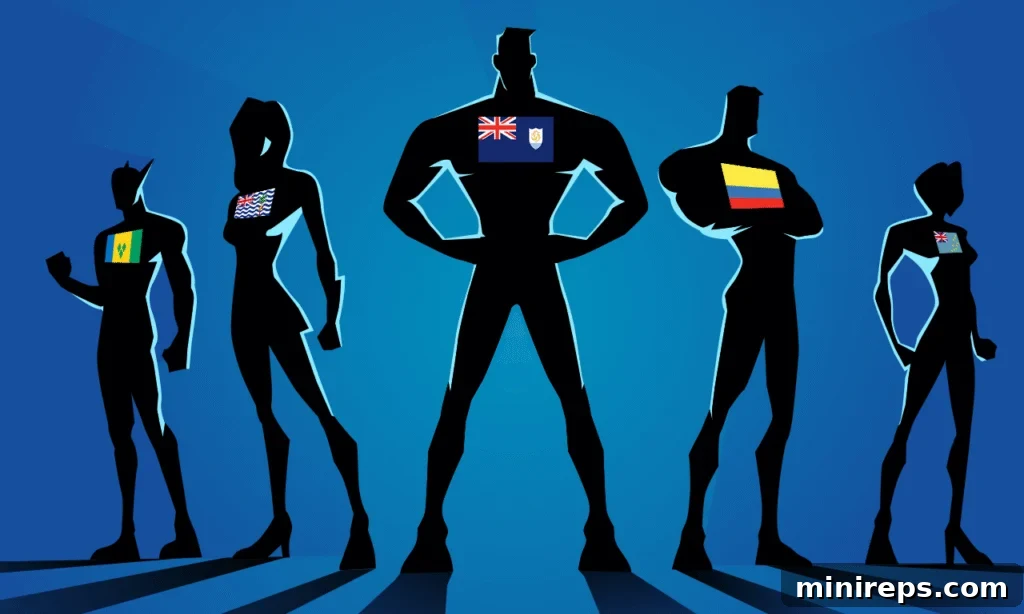
If you’re fascinated by how these tiny nations have capitalized on their digital assets and want to delve deeper into the economics and branding strategies behind their success, check out our comprehensive analysis. Discover which five small countries are currently dominating the global tech branding scene and how their ccTLDs are shaping the future of the internet:
RELATED ARTICLE
The ccTLD Giants: Five Tiny Countries Dominating Global Tech Branding