

Beyond .COM: Unlocking Strategic Advantages in the Evolving World of Domain Names
When the internet first emerged into the public consciousness in 1985, the digital landscape was a barren frontier, offering only a handful of foundational domain options. The initial set of top-level domains (TLDs) – including the now iconic .com, .net, .org, .edu, and .gov – were meticulously designed to categorize nascent websites based on their core subject matter or organizational type. Over the ensuing decades, the .com domain, a direct abbreviation of “commercial,” would transcend its original definition to become the undisputed titan of the domain world. Its ubiquity and instant recognition made it the gold standard for businesses and individuals alike. However, the digital realm is ever-evolving, and today, thanks to the introduction of the New Generic Top-Level Domains (ngTLD) program, the choices available to establish an online identity are vast and increasingly specialized, offering unprecedented flexibility and strategic opportunities for businesses and brands worldwide.
Credit: Domain Investing
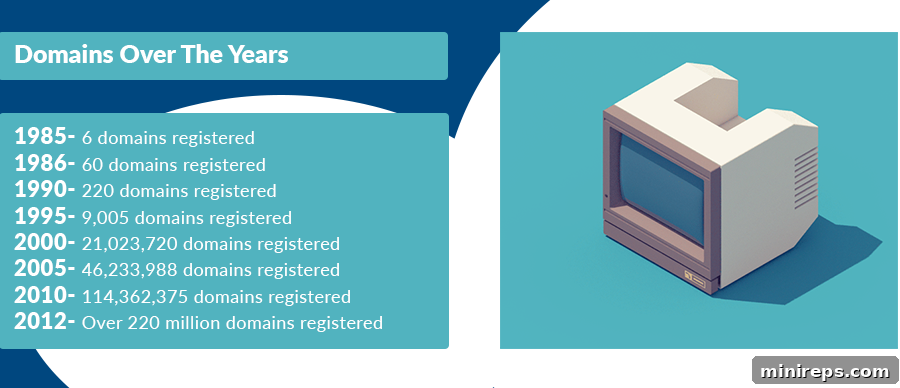
The turn of the millennium witnessed an exponential explosion in internet adoption, leading to a dramatic surge in domain registrations. By 2012, the number of registered domains had soared past an astonishing 220 million – a testament to the internet’s rapid expansion in less than twenty years. This pivotal year also marked the highly anticipated launch of the first wave of new generic domains. Driven by the Internet Corporation for Assigned Names and Numbers (ICANN), this ambitious program aimed to address the growing saturation of traditional TLDs and provide a more granular, relevant, and keyword-rich system for categorizing the internet. The goal was to offer businesses and individuals the ability to choose domain endings that were far more descriptive and targeted, allowing for greater specificity in branding and online identity. Today, this groundbreaking initiative has expanded to include over 1,200 new domain endings, with new options continuously being introduced each year, such as the widely celebrated .app domain launch, catering to the booming mobile application industry.
Credit: Verisign
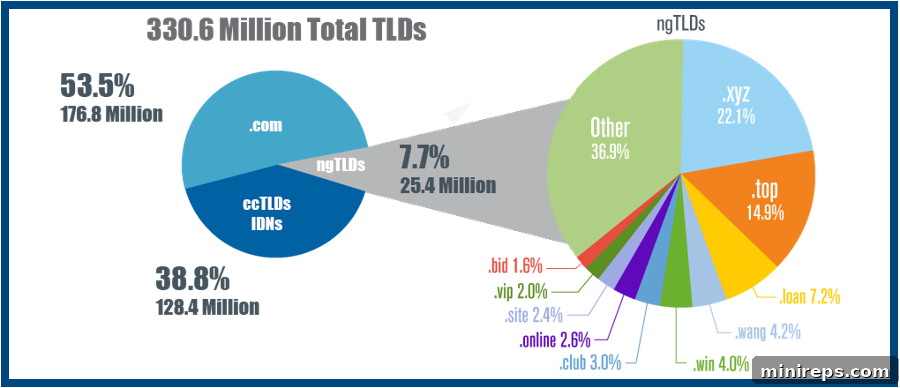
While the unparalleled dominance of .com, accounting for more than 50% of all registered domains, is undeniably impressive, it also highlights a significant reality: an entire half of the internet operates under different domain extensions. This diverse landscape includes country code top-level domains (ccTLDs), which are indispensable for businesses seeking to establish a localized presence. For instance, when navigating the web in France, encountering country code domains like .FR is commonplace, just as .AI domains are prominently used in Anguilla, especially by tech and artificial intelligence companies globally due to its suggestive nature. In the United States, where the internet’s commercial roots first took hold, .com has become so deeply ingrained that it effectively functions as our de facto ccTLD. Although a specific .US ccTLD exists, it is far less frequently utilized compared to country code domains in many other nations, underscoring the unique global position .com has achieved.
Despite their relatively smaller representation in the overall TLD ecosystem, new generic TLDs (ngTLDs) offer distinct and powerful advantages. The very fact that fewer domains are registered within the ngTLD space translates into a vastly increased opportunity for businesses, startups, and personal brands to secure short, memorable, and highly relevant domain names for their websites. This availability stands in stark contrast to the often-saturated .com market, where finding a concise and impactful domain can be a significant challenge or an exorbitant expense.
What Does Your Domain Name Say About Your Business? More Than You Think.

Credit: Domain Name Sales
In the digital age, a domain name is much more than just a web address; it’s a critical piece of digital real estate, an identifier that immediately communicates your brand’s essence and purpose. Just like in traditional business, location is everything, and in the online world, your domain name defines that location. The primary drawback of the venerable .com domain, for all its prestige, is its extreme saturation. Most premium, generic .com names – think “cupcakes.com” or “shoes.com” – were registered decades ago. If by some rare chance they become available, acquiring them typically comes with a prohibitive price tag, often costing an arm and a leg to acquire through secondary markets or brokers. This creates a significant barrier for new businesses, innovative startups, and even established mom-and-pop shops who are now realizing that a robust online presence is no longer optional but essential for success in today’s competitive market. These businesses, often late to the domain game, are frequently left with the unenviable choice of selecting a long, complicated, and hard-to-remember .com address, or, more strategically, considering the burgeoning opportunities offered by a new generic TLD.
A common question we encounter from businesses is regarding the optimal number of domains they should own for their brand. The truth is, there’s no universal “magic number.” Domain strategy is highly individualized. Some brands achieve immense success by meticulously focusing their efforts on a single, powerful domain name. Others adopt a multi-domain strategy, leveraging a combination of country code domains for essential brand protection against international cybersquatting – securing their brand in key markets – and specific ngTLDs for targeted marketing campaigns or niche product launches. For instance, a tech startup might own its .com, .io (for innovation), and .tech (for technology) domains to cover all bases and prevent competitors from encroaching on their digital territory. There is simply no one-size-fits-all answer when it comes to crafting an effective domain strategy for sustained online success; it requires careful consideration of branding, target audience, competitive landscape, and future growth aspirations.
ngTLD Keywords Provide Hidden Value and SEO Advantages
In the realm of search engine optimization (SEO), Domain Authority (DA) stands as a crucial metric. It’s a score, ranging from 1 to 100, developed by Moz, that predicts how likely a website is to rank in search engine results. This score is heavily influenced by the quantity and, crucially, the quality of inbound links pointing to a website. A groundbreaking case study meticulously conducted by the Domain Name Association (DNA) revealed a compelling insight: ngTLDs, on average, required a significantly lower Domain Authority score of just 4 to achieve favorable rankings in search results. In stark contrast, their .com counterparts had to contend with far greater competition and exert considerably more effort to be seen, primarily due to other critical factors such as the absence of highly relevant keywords directly embedded within both the domain name and, more importantly, the domain ending itself.
The strategic choice of a highly relevant domain extension offers palpable advantages not only in organic search results but also in achieving superior ranking for qualified keywords in paid marketing campaigns. Consider a user diligently searching for information on “cupcakes.” They are inherently more likely to click on a website address that explicitly contains the keyword they were searching for, especially if it appears in a domain like “bestcupcakes.bakery” or “cupcakerecipes.food“. For a vast majority of internet users, the domain name itself is one of the very first pieces of information they instinctively analyze when making a crucial decision about which website to visit. Website addresses that appear suspicious, overly long, or irrelevant are highly less likely to be chosen over a concise, keyword-rich domain name that clearly communicates its purpose. This psychological phenomenon is akin to why we are diligently taught to skim the sender’s domain in an email; it provides immediate, vital clues as to the legitimacy and trustworthiness of a website and the content it purportedly offers. Search engines, in turn, track these user engagement signals, rewarding domains that garner more clicks and longer user sessions with improved visibility.
Moreover, modern websites leveraging new domains like the increasingly popular .IO domain (often favored by tech and software companies) do not necessarily require years of accumulated domain authority to rank effectively for competitive and lucrative search queries that occur constantly throughout the day. A savvy business can establish a robust and credible online presence with significantly less initial effort by strategically incorporating relevant keywords both before and after the dot with a well-chosen ngTLD. This immediate relevance can dramatically accelerate the path to visibility and brand recognition, giving new market entrants a powerful edge in an incredibly crowded digital arena. The era of blindly defaulting to .com is fading; the future belongs to those who strategically embrace the diversity and specificity that new domain extensions offer.