


In today’s interconnected world, establishing a robust online presence is paramount for any business or brand looking to thrive. However, alongside this digital opportunity comes a significant and often underestimated challenge: the international threat of domain squatting. This aggressive practice can jeopardize brand integrity, financial stability, and customer trust. Effectively combating domain squatting requires a proactive and multifaceted approach, encompassing both defensive strategies and a deep understanding of the global digital landscape. Key to this defense is recognizing the crucial differences between a legitimate domainer and a malicious cybersquatter, as well as knowing the proper steps to take when a domain infringing on your trademark is registered by another party. While this threat exists universally, the international dimension of domain squatting escalates the risk due to inherent inconsistencies in securing and protecting intellectual property rights and trademarks across different jurisdictions worldwide.
Why the International Threat of Domain Squatting is Magnified
Managing a successful brand in the digital age is an exhaustive endeavor. Beyond the continuous innovation, marketing efforts, and customer engagement, brand custodians must meticulously monitor their intellectual property, especially their trademark portfolio. This vigilance extends beyond national borders, into an expansive and often unregulated global online landscape. The heightened risk of international domain squatting stems primarily from the vast disparities in legal frameworks and enforcement mechanisms across various countries.
Varied Legal Landscapes and Enforcement Challenges
Consider the stark contrast between countries like the United States and regions with less stringent intellectual property protections. In the U.S., robust legislation such as the Anticybersquatting Consumer Protection Act (ACPA) specifically targets cybersquatting, providing a powerful legal recourse for trademark holders. This act goes beyond standard trademark law by explicitly considering whether a domain name was registered with “bad faith intent to profit” from another’s trademark. To successfully prove a cybersquatting case in the United States, a complainant generally needs to demonstrate three key elements:
- You possess legitimate rights to the trademark (e.g., a registered trademark).
- The alleged cybersquatter lacks any legitimate rights or interest in the domain name.
- The domain name was registered, trafficked, or used in bad faith with the intent to profit from your trademark.
However, this level of protection is far from universal. Many countries, particularly those with emerging economies or different legal traditions, may have less developed or more lax laws concerning online intellectual property. This creates fertile ground for cybersquatters who strategically target such jurisdictions to register domain names that infringe on established foreign trademarks, knowing that legal recourse will be significantly more challenging and costly for the legitimate brand owner.
The Challenge of Overseas Trademark Registration and Anonymous Squatters
A significant hurdle arises if a cybersquatter manages to obtain a trademark for your brand name in a different country. In such scenarios, the legitimate brand owner might effectively lose their direct claim over the domain, forcing them into protracted and expensive international litigation, often incurring substantial legal fees and time. The territorial nature of trademark law means that a trademark registered in one country does not automatically grant rights in another. Squatters can exploit this by registering a similar or identical mark in a foreign country, thereby claiming a legitimate “right” to the corresponding domain name in that territory.
Furthermore, the problem is compounded by the anonymity offered by some domain registration services and jurisdictions. If a cybersquatter operates under an alias or utilizes privacy services that mask their identity, tracking them down and initiating legal proceedings becomes an arduous, if not impossible, task. This lack of transparency allows malicious actors to operate with relative impunity, making effective enforcement extremely difficult for global brands.
The “First Registered, First Served” Predicament: The China Example
Cybersquatting cases originating from countries like China have gained considerable attention due to their common targeting of popular American and Western brands. China operates on a “first registered, first served” basis for domain names, which means that the entity that first registers a domain name, regardless of intent or existing brand authority elsewhere, is generally granted rights to that name within the .CN namespace. This principle often applies not only to domain registrations but also to trademark filings, where the first to file can often secure the trademark, even if an identical mark is internationally recognized.
Chinese firms have notoriously exploited this system, securing questionable trademarks and domain names that directly infringe on well-known foreign brands. They then leverage these registrations to extract significant financial sums from the legitimate brand owners or to divert traffic to competing businesses. This practice is particularly concerning given China’s massive online population and the dominant position of its .CN domain, which, as data from Q4 2017 showed, consistently ranks among the top country code domains globally, making it a prime target for these activities.

Mitigating the Risk: Proactive Brand Protection and Defensive Strategies
Given the complexities and heightened risks, proactive measures are indispensable for safeguarding your brand. Defensive domain registrations are a critical first line of defense, especially for international brands, large corporations, and rapidly growing startups, all of whom are primary targets for international cybersquatting. A robust strategy involves more than just registering your primary domain name; it entails a comprehensive approach to managing your digital assets.
Creating a healthy and extensive domain portfolio is an effective way to significantly reduce the international threat of domain squatting. This includes:
- Registering exact match country code domains (ccTLDs) for your brand name in all relevant markets where you operate or plan to operate.
- Securing common misspellings or typographical errors (typosquatting protection) that could be used to divert traffic.
- Registering your brand name across various popular Top-Level Domains (TLDs) such as .com, .net, .org, and newer generic TLDs.
- Implementing a robust monitoring service that alerts you to new domain registrations that incorporate your brand name or variations of it.
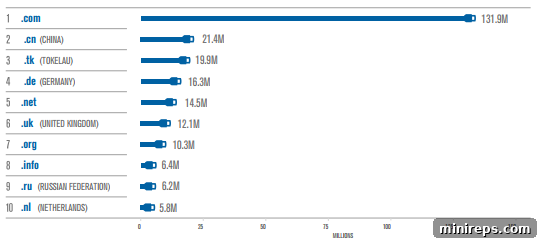
Photo Credit: The Domain Name Industry Brief, Verisign
Real-World Implications: Case Studies in International Cybersquatting
Case Study: Groupon Australia

A classic example of the challenges posed by international domain squatting is the battle faced by Groupon in Australia in 2011. As Groupon prepared for its highly anticipated launch Down Under, an existing Australian coupon brand named Scoopon strategically registered groupon.com.au, filed for the company name Groupon Pty Limited, and applied for the Groupon trademark in Australia, all just ahead of Groupon’s own efforts. Initially, Scoopon’s owners offered to sell the groupon.com.au domain name for a substantial sum of $286,000. However, they later altered their demands, insisting that Groupon purchase the entire Scoopon brand – a move that left Groupon with no alternative but to initiate a lawsuit against Scoopon for domain squatting and trademark infringement.
Groupon’s legal argument hinged on the claim that the Australian trademark was filed in bad faith, specifically to extort money or stifle competition. This legal battle, unfortunately, proved to be an incredibly expensive route, both in terms of time and financial resources for Groupon, underscoring the severe consequences of not having a fully protected brand presence in every market.
Case Study: Pinterest

The popular visual discovery platform Pinterest also found itself embroiled in a significant legal battle against a Chinese individual identified as a serial cybersquatter. This individual had a history of snatching up domain names and filing for trademarks of promising startups and emerging American brands globally, including highly strategic domains like pinterests.com and pinterest.de. In its lawsuit, Pinterest meticulously built a case demonstrating that pinterests.com was registered in bad faith, specifically noting its mimicry of Pinterest’s distinctive red-lettering and the site’s sole use for displaying unrelated advertisements, indicating clear intent to confuse consumers and profit from brand association.
While companies like Pinterest might have clear-cut cases of infringement in the United States thanks to strong domestic laws, challenging trademark filings and domain registrations in China and other foreign countries presents a far more intricate and daunting challenge. The jurisdictional hurdles, differing legal interpretations of “bad faith,” and the enforcement difficulties often allow squatters to operate with a degree of immunity.
Comprehensive Strategies for Brand Protection in the Digital Age
The internet remains an incredibly important and fiercely competitive landscape for brands. With recent research highlighting that a significant proportion – as high as one in six – of products sold online may be counterfeit, any unauthorized use or misuse of your brand’s likeness can have devastating repercussions. It can severely impact loyal customers, erode trust in your brand name, and ultimately lead to lost revenue and diminished brand equity. Therefore, a holistic and continuous approach to online portfolio monitoring is no longer optional but an absolute necessity.
Effective monitoring significantly reduces the myriad risks associated with domain name infringement, the proliferation of counterfeit products, and sophisticated phishing attacks designed to deceive your customers. Beyond mere monitoring, a robust defensive strategy hinges on a combination of legal, technical, and strategic measures:
- Strategic Trademark Registration: Register your trademark in all key global markets where your brand has an presence or intends to expand. Consider international trademark systems like the Madrid Protocol to streamline this process.
- Comprehensive Domain Portfolio Management: As previously emphasized, defensive domain registrations are the single best way to preempt and prevent the international threat of domain squatting. This includes not only your exact brand name in various TLDs and ccTLDs but also common misspellings, variations, and descriptive terms associated with your brand.
- Continuous Brand Monitoring Services: Utilize specialized services that actively scan the internet for new domain registrations, social media handles, and online content that might infringe upon your brand or intellectual property.
- Leveraging Dispute Resolution Policies: Understand and be prepared to use mechanisms like the Uniform Domain-Name Dispute-Resolution Policy (UDRP) offered by ICANN (Internet Corporation for Assigned Names and Numbers). UDRP provides a relatively fast and cost-effective means to recover infringing domain names, especially for clear-cut cases of bad faith registration, without resorting to traditional litigation.
- Engaging Expert Legal Counsel: Partner with intellectual property lawyers specializing in international law and domain name disputes. Their expertise is invaluable in navigating complex legal systems and initiating timely and effective legal action when necessary.
In essence, protecting your brand in the global digital arena requires vigilance, foresight, and a willingness to invest in comprehensive protection strategies. By staying ahead of potential threats and employing a multi-layered defense, brands can safeguard their reputation, secure their digital assets, and ensure continued growth and customer loyalty in an increasingly complex online world.