
In the evolving landscape of digital communication, DMARC (Domain-based Message Authentication, Reporting, and Conformance) stands as an indispensable pillar of modern email security. Alongside its foundational counterparts, SPF (Sender Policy Framework) and DKIM (DomainKeys Identified Mail), DMARC establishes a critical policy framework. This robust protocol empowers organizations to explicitly instruct receiving mail servers on how to handle emails that fail authentication checks, thereby preventing malicious actors from spoofing your domain and impersonating your brand. It’s the ultimate line of defense against phishing, BEC (Business Email Compromise), and other sophisticated email-borne attacks that constantly threaten businesses and their customers.
Despite DMARC’s undisputed importance, its inherent reporting mechanisms, particularly the Aggregate Reports (RUA), have historically presented a significant operational hurdle for many organizations. These reports, crucial for understanding who is sending emails on your behalf and whether they pass authentication, arrive as highly compressed, machine-readable XML files. For large enterprises dispatching thousands, if not millions, of emails daily, the sheer volume of data contained within these reports is nothing short of overwhelming. This deluge of raw information often leaves security teams drowning in data rather than effectively leveraging it for proactive defense.
The critical question facing cybersecurity professionals today is whether traditional, human-centric DMARC analysis methods can possibly keep pace. Armed with little more than spreadsheets, manual tools, and sheer determination, can security teams realistically process this immense information overload? Or has the era of purely manual DMARC analysis been rendered obsolete, overwhelmed by the exponential scale of modern email traffic and the relentless, accelerating pace of AI-driven cyber threats?
The Data Deluge: Why Manual DMARC Analysis Falls Short
At the heart of the DMARC reporting challenge lies its deliberately raw and machine-centric format. When a mail server (such as Gmail, Outlook, or any other email provider) processes an incoming message and sends a DMARC report, it provides a massive, compressed data dump in XML format. This design prioritizes efficiency for automated systems, but it presents a formidable barrier for human interpretation. The data primarily consists of sending IP addresses and the volume of mail, offering little immediate context. Crucially, it doesn’t provide the user-friendly “friendly name” of the service responsible for sending the email—you won’t see “Mailchimp” or “HubSpot,” but rather a string of numbers.
A security analyst attempting to perform manual DMARC analysis is confronted with a complex, incredibly time-consuming, and highly error-prone process. The initial step involves decoding the intricate XML structure, which itself requires specialized knowledge. Once parsed, the analyst must then meticulously cross-reference vast and constantly changing IP address ranges against known vendor lists, cloud providers, and internal server records. This painstaking effort is required to determine whether an authentication failure originated from a legitimate marketing platform, a forgotten internal server (a classic “Shadow IT” issue), or a truly malicious actor attempting a sophisticated phishing attack.
The inherent tediousness and high potential for human error in this process introduce unacceptable delays. In today’s threat landscape, where generative AI can be leveraged to launch hyper-realistic, highly personalized spoofing and phishing attempts globally within minutes, waiting days or even hours to identify and mitigate a new attack is a recipe for disaster. This sluggish response time directly translates into tangible financial losses, data breaches, significant reputational damage, and erosion of customer trust. Furthermore, prolonged exposure to unaddressed vulnerabilities can lead to regulatory non-compliance, incurring substantial fines and further damaging an organization’s standing.
Beyond the immediate threats, manual analysis frequently struggles to uncover the insidious “Shadow IT” problem. These are the often-overlooked applications, internal test servers, old marketing platforms, or third-party services sending mail on behalf of an organization without proper DMARC alignment. Sifting through the overwhelming noise of legitimate email traffic and false positives to pinpoint these legitimate yet misconfigured sources becomes virtually impossible without advanced automation. Without visibility into Shadow IT, an organization’s email ecosystem remains vulnerable, providing covert entry points for attackers.
Empower Your Email Security: Get AI and Machine Learning on Your Side
To effectively combat the velocity, volume, and inherent complexity of DMARC data, a growing number of forward-thinking businesses are embracing automated DMARC solutions that leverage the power of Artificial Intelligence (AI) and Machine Learning (ML). These intelligent tools fundamentally transform DMARC from a passive reporting standard into an active, proactive, and intelligent defense mechanism, capable of adapting to the ever-evolving threat landscape.
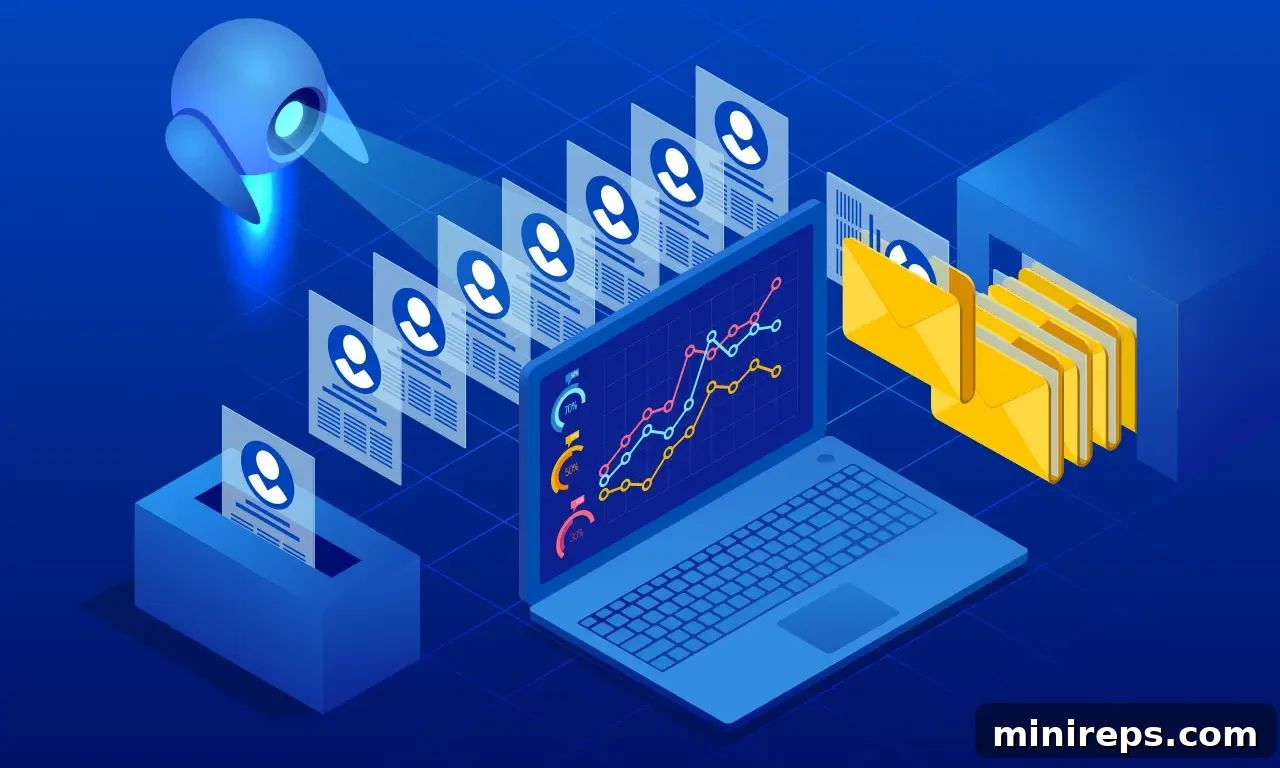
Firstly, the automation layer within these platforms addresses the logistical nightmare of raw data processing. Automated DMARC solutions are designed to automatically ingest the raw, compressed XML reports from numerous receiving servers, parse the data, normalize it into a consistent format, and then present it on intuitive, clear, and visual dashboards. Crucially, sophisticated AI models, often trained on vast datasets of email sending patterns and known service providers, are employed to map generic sending IP addresses to their corresponding friendly vendors and services. This eliminates the analyst’s biggest manual roadblock—the laborious and error-prone process of reverse IP lookup—and immediately provides actionable context.
Secondly, advanced Machine Learning models play a pivotal role in intelligent threat detection. These models are meticulously trained to establish a dynamic baseline of “normal” email traffic patterns for your domain. This baseline encompasses typical sending volumes, originating IP addresses, geographical distribution, and historical authentication success rates for each legitimate sender. When new DMARC reports arrive, the AI can instantly compare incoming data against this established baseline, allowing it to rapidly and accurately flag any activity that deviates significantly from the expected character. Anomalies that would be nearly impossible for a human to spot in a sea of data are immediately highlighted, including:
- An unusual and unexpected spike in mail volume from a previously dormant or low-activity IP address, signaling a potential compromise or unauthorized use.
- A sudden surge of failing mail originating from a suspicious or untypical geography, indicating a globally distributed attack campaign.
- A low-volume, continuous stream of carefully crafted, spoofed messages that a human analyst might easily dismiss as background noise, but which could represent a targeted attack attempting to evade detection.
- New sending domains or IP ranges appearing without prior authorization or configuration, indicating new Shadow IT instances or malicious attempts to leverage your brand.
- Inconsistencies in authentication results for known legitimate senders, suggesting configuration issues or a compromise of a third-party service.
This unparalleled level of anomaly detection allows security teams to shift their focus dramatically. Instead of sifting through mountains of data, they can now exclusively concentrate their expertise and resources on the small percentage of highly scored threats and critical alerts that require immediate human investigation and intervention.
The Evolved Role: The New DMARC Analyst as a Strategic Security Partner
Does the advent of AI and automated DMARC analysis signify the obsolescence of the human DMARC analyst? Absolutely not. On the contrary, AI doesn’t replace the human; it profoundly enhances and elevates their role. While AI provides the unparalleled speed and scale required to process and contextualize vast quantities of DMARC data, the human element remains absolutely vital for nuanced context, intricate risk assessment, strategic decision-making, and navigating the complexities of organizational policy and communication.
The modern DMARC analyst transforms into a sophisticated cyber-investigator. They leverage the AI-generated alerts and dashboards not as definitive answers, but as their initial, highly accurate tip-offs. The AI performs the heavy lifting of data correlation and anomaly detection, presenting the analyst with a prioritized list of potential threats or misconfigurations. It is then the analyst’s unique human intelligence, experience, and understanding of the business context that comes into play. Only the analyst can conclusively determine if a newly flagged, high-volume IP address with authentication failures is a genuine marketing service that inadvertently forgot to renew a certificate or update a DNS record, or if it represents a sophisticated malicious entity attempting to spoof the CEO for a Business Email Compromise (BEC) scam.
Their role effectively shifts from tedious, error-prone data parsing and manual correlation to strategic enforcement and incident response coordination. Armed with clean, contextualized data provided by AI, the analyst can make informed, risk-assessed decisions regarding DMARC policy adjustments. They manage critical stakeholder communications, ensuring that legitimate email senders are properly configured and that internal teams understand the implications of DMARC enforcement. Most importantly, they strategically enforce the DMARC policy from an initial state of p=none (monitoring only, allowing comprehensive data collection) to a more protective p=quarantine (directing non-compliant emails to spam or junk folders), and ultimately to the strongest level, p=reject (blocking all non-compliant emails from reaching recipients). This gradual, data-driven progression is crucial for avoiding disruption to legitimate email flows while maximizing protection. In essence, AI dramatically augments the analyst’s capabilities, empowering them to become a strategic security partner and a proactive defender of the organization’s digital identity, rather than a mere data entry clerk.
Fortify Your Digital Presence with Expert Managed DMARC Services
In today’s cyber-threat landscape, achieving full DMARC enforcement is no longer a luxury or an optional security measure; it is an absolute necessity. Major email providers such as Google, Yahoo, and Outlook have made DMARC a fundamental requirement for optimal email deliverability and robust inbox protection against spoofing and phishing. To successfully implement, monitor, and maintain this critical defense without inadvertently disrupting legitimate email communications, advanced automation and expert guidance are absolutely essential.
Navigating the complexities of DMARC deployment, understanding the nuances of policy enforcement, and consistently monitoring aggregate reports requires specialized knowledge and dedicated resources. Many organizations, particularly those with limited in-house cybersecurity teams, find this a significant challenge. This is where 101domain’s Managed DMARC service, powered by OnDMARC, provides an invaluable solution. Our service delivers not only the cutting-edge technology but also the seasoned expertise required to smoothly and securely transition your domain from a vulnerable monitoring state to active, comprehensive protection.
OnDMARC automates the entire process of XML report ingestion and parsing, transforming raw, unintelligible data into clear, actionable intelligence. It provides unparalleled visibility into all your email sending sources, both known and unknown, by leveraging intelligent algorithms to identify, categorize, and prioritize threats instantly. With OnDMARC, your security team gains the full power of machine learning to effortlessly navigate the vast ocean of DMARC data, receiving human-validated, actionable steps to swiftly close authentication gaps. This comprehensive approach allows your organization to reach full DMARC compliance faster, comprehensively protect your brand from the most sophisticated AI-driven phishing and spoofing attacks, and, critically, ensure your legitimate emails consistently reach their intended inboxes, safeguarding your critical communications and reputation.
Moreover, for organizations that genuinely lack the internal resources, expertise, or bandwidth to manage this data and respond to alerts, our Managed Service Plans offer a complete, hands-off solution. Under these plans, our dedicated team will proactively monitor and analyze your DMARC status, handle policy adjustments, and provide continuous oversight on your behalf. This ensures your email security posture remains optimized without burdening your internal staff.
The cyber threat landscape is evolving at an unprecedented pace, with attackers constantly refining their techniques. Don’t allow your organization to fall behind. Take decisive control of your email security today by implementing a robust, AI-powered DMARC strategy, and protect your domain, your brand, and your customers from the escalating dangers of email fraud.
Need Expert Assistance with Your DMARC Setup and Management?
Discover how 101domain’s Managed DMARC Services can streamline your email security. Let our experts handle the heavy lifting, from comprehensive policy setup and continuous monitoring to detailed reporting and swift threat mitigation, ensuring your emails are consistently secure and delivered.