
Congratulations on embarking on your new business venture! This is truly an exhilarating phase, a time when your innovative ideas begin to materialize and your dedication starts to yield tangible results. Establishing your brand’s online presence, which once seemed daunting, is now more accessible than ever. By following this comprehensive checklist, you can lay the complete foundation for your digital footprint and project your brand to the world today.
In today’s hyper-connected world, an online presence isn’t merely an advantage; it’s an absolute necessity. Your digital storefront, much like a physical one, serves as the primary gateway for potential customers to discover, engage with, and ultimately patronize your business. It’s where your brand story unfolds, where products and services are showcased, and where trust is built. Navigating the initial steps of bringing your business online might seem complex, but with a clear roadmap, you’ll find it’s a straightforward process. This guide will demystify the essential elements required to build a robust, secure, and professional online platform for your thriving enterprise.
1. Secure Your Distinctive Domain Name
For those new to the digital landscape, the term “domain name” might sound unfamiliar. Fear not, it’s simpler than it appears. A domain name is essentially your website’s unique address on the internet, often referred to as a URL. Think of it as your digital street address, guiding visitors directly to your online home.
The operational mechanism of domain names on the internet mirrors that of physical addresses in the real world. Each segment of a domain name provides specific navigational cues, enabling web browsers to pinpoint and load your website. This intricate system ensures that when someone types “www.YourBrandName.com,” their browser knows precisely where to go.
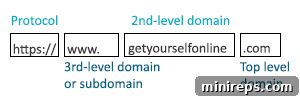
The second-level domain (SLD) is the customizable core of your web address, typically offering context about the content visitors will encounter on your site. For instance, a domain like JazzysCoffeeHouse.net immediately signals that you’re about to visit the official website for Jazzy’s cafe, conveying brand identity and purpose at a glance. Choosing a memorable, brand-aligned SLD is paramount as it forms the most recognizable part of your web address and significantly contributes to brand recall.
The top-level domain (TLD), found after the final dot on the far right, holds significant importance. Historically, choices for TLDs were limited, which is why most people are primarily familiar with traditional options such as .COM, .NET, and .ORG. However, the digital landscape has evolved dramatically. Today, you have an unprecedented degree of freedom to personalize what comes after the dot, aligning it more closely with your brand’s unique identity and industry.
Beyond country-code TLDs (ccTLDs) like .FR for France or .CN for China, which are excellent for targeting specific geographical markets, a vast array of new descriptive generic top-level domains (gTLDs) has emerged. These include highly relevant options such as .CAFE, .SHOP, .FITNESS, and .FARM. These modern TLDs offer unparalleled opportunities for creativity, enhanced memorability, and precise brand alignment, allowing your domain name to immediately communicate your business’s core offering.
Choosing the Right Domain Name for Your Business:
- Keep it Brand-Centric: Your domain name should ideally reflect your business name or a key aspect of your brand.
- Make it Memorable: Easy to remember, spell, and pronounce. Avoid complex words, numbers, or hyphens if possible.
- Prioritize .COM (if available): While new gTLDs offer flexibility, .COM remains the most trusted and universally recognized TLD. If your ideal .com isn’t available, explore relevant gTLDs.
- Consider Keywords (sparingly): Including a relevant keyword can subtly boost SEO, but avoid “keyword stuffing” which can look spammy.
- Explore New gTLDs: If your brand is niche or innovative, a descriptive gTLD can provide a unique edge and instant recognition (e.g., yourcompany.tech, yourbusiness.art).
- Check Availability: Always verify that your desired domain name is available across different TLDs.
If you already have a name in mind, you can check its availability directly through a domain registrar like 101domain.com. If you’re unsure about the ideal domain ending, explore the diverse categories available: country code domains by region for local targeting, traditional legacy domain names, and the exciting new possibilities offered by new generic domains. Taking the time to select the perfect domain name is an investment that will pay dividends in brand recognition and online visibility.
2. Power Your Online Presence with Web Hosting or a Website Builder
Once you’ve secured your domain name, the next critical step is to provide a home for your website. This is where web hosting comes into play. To new users, “hosting” might sound like a highly technical and intimidating term. In its essence, however, hosting is simply a service that allows your website to be accessible on the internet. It provides the necessary infrastructure – servers, storage, and bandwidth – to store your website’s files and deliver them to users worldwide when they type in your domain name.
Think of your domain name as your property’s address, and web hosting as the plot of land or the building itself where your business (website) resides. Without hosting, your website files would have nowhere to live, and your domain name would lead to an empty lot. A robust hosting package typically encompasses everything you need to run, automate, and grow your online applications. This often includes resources for your domains, your website content, and professional email services, frequently offering one-click installations for popular web software like WordPress. This comprehensive approach grants you unlimited control and flexibility to achieve your digital aspirations.
Choosing the Right Web Hosting:
- Reliability and Uptime: Look for providers guaranteeing high uptime (e.g., 99.9%), ensuring your site is always available to visitors.
- Speed and Performance: Fast loading times are crucial for user experience and SEO. Opt for hosting with SSD storage and CDN integration.
- Scalability: Choose a plan that can grow with your business, allowing for easy upgrades as your traffic increases.
- Customer Support: 24/7 technical support is invaluable for troubleshooting any issues.
- Security Features: Ensure your host offers firewalls, malware scanning, and DDoS protection.
- Backup Solutions: Regular automated backups are essential for disaster recovery.
- Control Panel: An intuitive control panel (like cPanel) simplifies website management.
Alternatively: Streamline with a Website Builder
The primary reason for registering your domain name is most likely to construct a website—a digital hub where customers can effortlessly locate your business and where you can cultivate a unique online presence. This might range from a simple informational site to a sophisticated online store designed to sell and promote your products and services.
When we introduce the concept of an Easy Website Builder to aspiring entrepreneurs, an initial apprehension often arises at the thought of designing a website from scratch. However, as soon as they engage with the platform, they quickly grasp its remarkable ease of use. A modern website builder provides all the necessary tools in an intuitive, drag-and-drop interface. You simply drag and drop elements like text boxes, images, contact forms, and buttons into place. With minimal effort and in remarkably little time, you can launch a fully functional, live website on the internet. Go ahead, add “web designer” to your resume; your secret is safe with us!
Website builders are particularly well-suited for small businesses, startups, and individuals without coding expertise, offering a cost-effective and time-efficient solution to establish a professional online presence. Many builders also include integrated hosting, making it an all-in-one solution for your digital needs.
Elevate Your Communication with Professional Email
Email remains an indispensable method of communication in contemporary business, serving critical functions across marketing, sales, customer support, and internal team collaboration. In an age where digital trust is paramount, customers are more inclined to conduct business with brands they perceive as credible and professional.
Utilizing free email services such as Gmail or Yahoo for business correspondence can inadvertently cast your brand in an unfavorable light, making it appear less reputable, potentially suspicious, or simply unprofessional. Conversely, a custom email address that perfectly matches your domain (e.g., [email protected]) instantly communicates trust, reinforces brand identity with every message sent, and acts as powerful, continuous advertising. This professionalism can significantly improve click-through rates for your email marketing campaigns and consistently guide potential customers back to your official online presence, strengthening your brand’s authority and reach.
Benefits of Professional Email:
- Enhanced Credibility: Builds immediate trust with clients and partners.
- Consistent Branding: Every email reinforces your brand identity.
- Marketing Advantage: Free advertising and higher engagement rates for campaigns.
- Improved Security: Often comes with robust security features and spam filters.
- Full Control: Manage multiple mailboxes, aliases, and forwarding options.
3. Fortify Your Website with SSL Certificates
In the digital realm, security is not just an option; it’s a fundamental requirement. SSL Certificates (Secure Sockets Layer) furnish your website with an essential layer of security and trust, visibly demonstrating to your customers that you prioritize and exceed standard measures to safeguard their private information. SSL Certificates are not merely beneficial; they are 100% necessary for e-commerce platforms, any website that collects sensitive personal data, and any online entity that facilitates financial transactions.
Just as you might proudly display an award or a diploma in your physical office, your website showcases its SSL certificate in the address bar of a web browser. This is indicated by the presence of “HTTPS” (Hypertext Transfer Protocol Secure) at the beginning of your website’s URL, often accompanied by a padlock icon. The crucial “S” in HTTPS stands for “secure” and unequivocally assures your website visitors that their data transmission is encrypted, making it virtually impervious to interception or hacking, unlike the easily compromised standard HTTP protocol.
Why SSL is Non-Negotiable:
- Data Encryption: Protects sensitive information like credit card numbers, login credentials, and personal details from cyber threats.
- Builds Customer Trust: The “secure” indicator instills confidence, making visitors more likely to engage and transact.
- SEO Advantage: Google officially uses HTTPS as a ranking signal, meaning secure sites often rank higher in search results.
- Avoids “Not Secure” Warnings: Browsers actively warn users about insecure HTTP sites, deterring visitors and increasing bounce rates.
- Authenticates Your Website: Verifies your website’s identity, preventing phishing attacks.
- Compliance: Essential for PCI DSS compliance if you process credit card payments.
Types of SSL Certificates:
- Domain Validated (DV SSL): Basic validation, quick issuance, suitable for blogs and informational sites.
- Organization Validated (OV SSL): Requires more rigorous validation of your organization, suitable for businesses.
- Extended Validation (EV SSL): The highest level of validation, often displayed with a green address bar (depending on browser), ideal for e-commerce and financial institutions.
- Wildcard SSL: Secures your main domain and all its subdomains.
- Multi-Domain SSL (SAN SSL): Secures multiple distinct domains and subdomains under a single certificate.
Implementing an SSL certificate is a straightforward process, often offered directly through your web hosting provider or domain registrar. Once installed, it automatically encrypts all data passing between your website and your visitors, providing peace of mind for both you and your customers.
Once you have meticulously checked off these foundational steps from your list – securing a memorable domain name, establishing reliable web hosting or an intuitive website builder, setting up professional email, and implementing a robust SSL certificate – you will be exceptionally well-positioned to embark on the journey of growing your brand digitally. These elements are not just features; they are the bedrock of a successful, credible, and secure online presence, paving the way for your business’s sustained growth and prosperity in the digital age.